
June 2025 Paper 1 Q14
14 In this question the \(\mathbf{i}\) and \(\mathbf{j}\) vectors are horizontal and vertically upward respectively.
A particle of mass 5 kg is at rest on a rough horizontal shelf. The coefficient of friction between the particle and the shelf is \(\mu\).
Determine the value of \(\mu\). [5]
The force \(\mathbf{P}\) is removed. One end of the shelf is lifted so that it is inclined at \(\alpha^\circ\) to the horizontal.
Show that \(\alpha = 17.2\) to 3 significant figures. [4]
Given that the particle remains in contact with the shelf, determine the time after projection at which the particle first comes to rest. [6]
| Scheme | Marks | AO |
|---|---|---|
| \([-5g\mathbf{j} + R\mathbf{j} \pm F\mathbf{i} + 9\mathbf{i} + 20\mathbf{j} = \mathbf{0}]\) | ||
| Horizontal component \(F = 9\) | B1 | 3.1b |
| Vertical direction \(R - 5g + 20 = 0\) | M1 | 3.1b |
| \(R = 5g - 20\) | A1 | 1.1 |
| On the point of sliding \(F = \mu R\) so | M1 | 3.4 |
| So \(\mu = \dfrac{9}{29} = [0.310\) to 3 sf\(]\) | A1FT | 1.1 |
| [5] |
Notes
Allow wrong or missing vector equation
B1: Soi. Allow \(\boldsymbol{F} = -9\mathbf{i}\) or \(F = -9\)
M1: Soi Vertical equation – weight and 20 involved and not 9.
Allow sign errors
A1: Correct equation soi
M1: Uses their \(F\) and \(R\) to evaluate \(\mu\).
Where \(F = \mu\times 5g\) is seen it must be explicit that \(5g\) is their reaction and not weight
A1FT: FT their \(R\) and \(F\).
Final answer must follow from their working and be positive
Ignore unsupported \(\mu = 0.310\) seen.
| Scheme | Marks | AO |
|---|---|---|
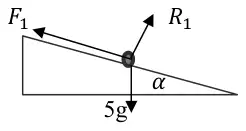 | ||
| Resolve perpendicular \(R_1 = 5g\cos\alpha\) | B1 | 3.4 |
| Resolve parallel \(F_1 = 5g\sin\alpha\) | B1 | 3.3 |
| \(F_1 = \dfrac{9}{29}R_1\) so \(\tan\alpha = \mu\left[=\dfrac{9}{29}\right]\) | M1 | 1.1 |
| \(\tan^{-1}\dfrac{9}{29} = 17.2^\circ\) | A1 | 2.1 |
| [4] |
Notes
Condone repeated use of \(F\) and \(R\) throughout even though their values have changed
B1: Allow \(R - 5g\cos\alpha = 0\) or \(F = \mu\times 5g\cos\alpha\) seen explicitly
B1: Allow for \(5g\sin\alpha = \mu\times 5g\cos\alpha\)
Allow sin/cos interchange if consistent with their \(R_1\)
M1: Allow for fraction which simplifies to 0.310 or better.
FT their \(\mu\) or 0.310
May be a quoted formula following B0B0
A1: AG must follow \(\mu = 0.310\) correctly calculated in (a)
| Scheme | Marks | AO |
|---|---|---|
| N2L up the slope \(-\left(5g\sin 17.2^\circ + \dfrac{9}{29}5g\cos 17.2^\circ\right) = 5a\) | B1 B1FT M1 | 3.3 3.4 3.1b |
| \(a = -5.80\ldots\) | A1 | 1.1 |
| \(v = u + at\) with \(v = 0,\ u = 5\) and their \(a\) | M1 | 3.4 |
| \(t = 0.862\) s | A1FT | 1.1 |
| [6] |
Notes
B1: Correct weight term seen (Allow \(\pm 14.5\) oe)
B1FT: Friction term seen FT their \(\mu\) (Allow \(\pm 14.5\) oe)
M1: Formulate equation of motion with their weight. Allow wrong or missing friction. Allow sign errors
No extra forces.
A1: Soi
Allow 5.8 if down the slope used as positive direction clear (eg on diagram, or \(u = -5\) or \(a = -5.8\) used subsequently)
M1: suvat equation(s) leading to a value for \(t\). Allow sign errors
A1FT: FT their acceleration \(\neq \pm g\)
Using \(\alpha = \tan^{-1}\frac{9}{29}\) gives 0.86067