
June 2024 Paper 1 Q16
16 A block of mass \(m\) kg rests on rough horizontal ground. The coefficient of friction between the block and the ground is \(\mu\). A force of magnitude \(T\) N is applied at an angle \(\theta\) radians above the horizontal as shown in the diagram and the block slides without tilting or lifting.
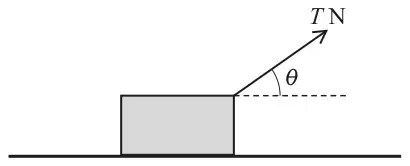
For a fixed value of \(T\), the acceleration of the block depends on the value of \(\theta\). The acceleration has its greatest value when \(\theta = \alpha\).
| Scheme | Marks | AO |
|---|---|---|
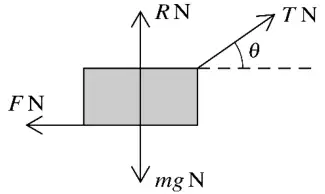 | ||
| Resolve vertically \(R = mg - T\sin\theta\) | B1 | 3.1a |
| Motion so \(F = \mu R\) \(F = \mu(mg - T\sin\theta)\) | M1 | 3.3 |
| Resolve horizontally \(T\cos\theta - F = ma\) \(ma = T\cos\theta - \mu mg + T\mu\sin\theta\) | M1 | 3.1a |
| \(a = \dfrac{T}{m}\cos\theta - \mu g + \dfrac{T}{m}\mu\sin\theta\) | A1 | 2.1 |
| [4] |
Notes
B1: Must be explicit – may be seen on the diagram.
Allow \(R + T\sin\theta = mg\) if \(F = \mu(mg - T\sin\theta)\) also seen
M1: Allow only if \(R\) seen explicitly or correct vertical equation seen
Allow \(F = \mu mg\) only if \(R = mg\) seen explicitly or on the diagram
M1: All forces correct and no extras. Allow sign errors
A1: AG Complete argument needed
| Scheme | Marks | AO |
|---|---|---|
| \(\dfrac{\mathrm{d}a}{\mathrm{d}\theta} = -\dfrac{T}{m}\sin\theta + \dfrac{T}{m}\mu\cos\theta\) | M1 | 3.1a |
| \(-\dfrac{T}{m}\sin\alpha + \dfrac{T}{m}\mu\cos\alpha = 0\) | M1 | 1.1a |
| \(\dfrac{\sin\alpha}{\cos\alpha} = \mu\) so \(\alpha = \tan^{-1}\mu\) | A1 | 1.1 |
| [3] |
Notes
M1: Attempt to differentiate wrt \(\theta\)
M1: Equate their derivative to 0 and attempt to rearrange using a trig identity.
Condone using \(\theta\) not \(\alpha\)
A1: Must be \(\alpha =\)
Also allow for \(\alpha = \frac{\pi}{2} - \tan^{-1}\frac{1}{\mu}\)
Alternative solution
| Scheme | Marks | AO |
|---|---|---|
| Maximum \(a\) when \(\frac{T}{m}(\cos\theta + \mu\sin\theta)\) is max | ||
| Acceleration is \((R\cos(\theta - \beta))\) where \(\beta = \tan^{-1}\mu\) | M1 M1 | |
| Max acceleration when \((\alpha - \beta) = 0\) | ||
| Giving \(\alpha = \tan^{-1}\mu\) | A1 |
M1: Uses trig identity
M1: Attempt to find the value of \(\beta\)
A1: Must be \(\alpha =\)
Also allow for \(\alpha = \frac{\pi}{2} - \tan^{-1}\frac{1}{\mu}\)