
C2 January 2010 Q8
8.
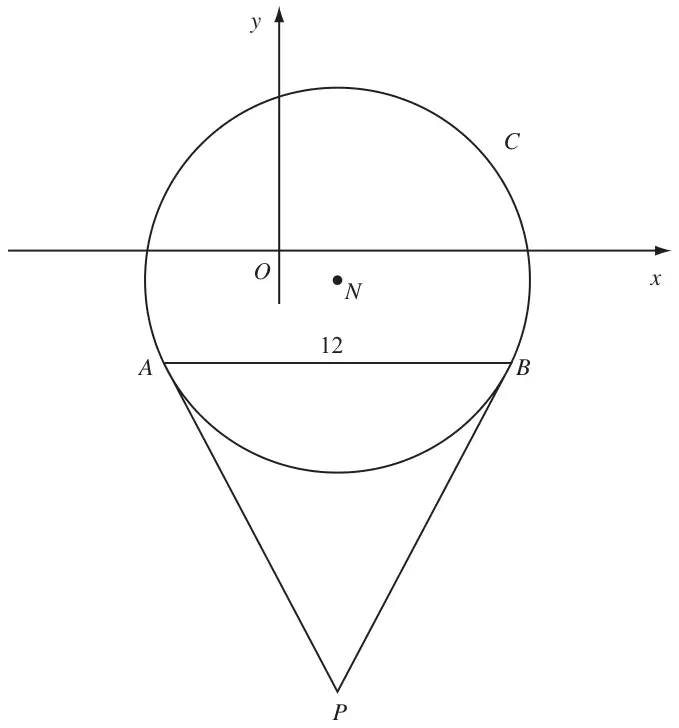
Figure 3 shows a sketch of the circle \(C\) with centre \(N\) and equation\[(x - 2)^2 + (y + 1)^2 = \frac{169}{4}\]
The chord \(AB\) of \(C\) is parallel to the \(x\)-axis, lies below the \(x\)-axis and is of length 12 units as shown in Figure 3.
The tangents to \(C\) at the points \(A\) and \(B\) meet at the point \(P\).
| Scheme | Marks |
|---|---|
| \(N\,(2,\ \text{-}1)\) | B1, B1 |
| (2) |
Notes
B1 for 2 (\(\alpha\)) , B1 for \(-1\)
| Scheme | Marks |
|---|---|
| \(r = \sqrt{\dfrac{169}{4}} = \dfrac{13}{2} = 6.5\) | B1 |
| (1) |
Notes
B1 for 6.5 o.e.
| Scheme | Marks |
|---|---|
| Complete Method to find \(x\) coordinates, \(x_2 - x_1 = 12\) and \(\dfrac{x_1 + x_2}{2} = 2\) then solve | M1 |
| To obtain \(\ x_1 = -4,\quad x_2 = 8\) | A1ft A1ft |
| Complete Method to find \(y\) coordinates, using equation of circle or Pythagoras i.e. let \(d\) be the distance below \(N\) of \(A\) then \(d^2 = 6.5^2 - 6^2\ \Rightarrow\ d = 2.5 \Rightarrow y = ..\) | M1 |
| So \(\ y_2 = y_1 = -3.5\) | A1 |
| (5) |
Notes
1st M1 for finding \(x\) coordinates – may be awarded if either \(x\) co-ord is correct
A1ft,A1ft are for \(\alpha - 6\) and \(\alpha + 6\) if \(x\) coordinate of \(N\) is \(\alpha\)
2nd M1 for a method to find \(y\) coordinates – may be given if \(y\) co-ordinate is correct
A marks is for –3.5 only.
| Scheme | Marks |
|---|---|
| Let \(A\hat{N}B = 2\theta\ \Rightarrow\ \sin\theta = \dfrac{6}{\text{"}6.5\text{"}}\ \Rightarrow\ \theta = (67.38)\ldots\) | M1 |
| So angle \(ANB\) is 134.8 \(*\) | A1 |
| (2) |
Notes
M1 for a full method to find \(\theta\) or angle \(ANB\) (eg sine rule or cosine rule directly or finding another angle and using angles of triangle.) ft their 6.5 from radius or wrong \(\boldsymbol{y}\).
(cos \(AN\)B \(= \dfrac{\text{"}6.5\text{"}^2 + \text{"}6.5\text{"}^2 - 12^2}{2 \times \text{"}6.5\text{"} \times \text{"}6.5\text{"}} = \)-0.704)
A1 is a printed answer and must be 134.8 – do not accept 134.76.
| Scheme | Marks |
|---|---|
| \(AP\) is perpendicular to \(AN\) so using triangle \(ANP\quad \tan\theta = \dfrac{AP}{\text{"}6.5\text{"}}\) | M1 |
| Therefore \(\quad AP = 15.6\) | A1cao |
| (2) | |
| [12] |
Notes
M1 for a full method to find \(AP\)
Alternative Methods
N.B. May use triangle \(AXP\) where \(X\) is the mid point of \(AB\). Or may use triangle ABP. From circle theorems may use angle \(BAP\) = 67.38 or some variation.
Eg \(\dfrac{AP}{\sin 67.4} = \dfrac{12}{\sin 45.2}\), \(AP = \dfrac{6}{\sin 22.6}\) or \(AP = \dfrac{6}{\cos 67.4}\) are each worth M1