
C1 January 2010 Q9
9.
The point \(A\) with \(x\)-coordinate \(-1\) and the point \(B\) with \(x\)-coordinate 3 lie on the curve \(C\).
| Scheme | Marks |
|---|---|
| \(x(x^2 - 4)\) Factor \(x\) seen in a correct factorised form of the expression. | B1 |
| \(= x(x - 2)(x + 2)\) M: Attempt to factorise quadratic (general principles). Accept \((x - 0)\) or \((x + 0)\) instead of \(x\) at any stage. Factorisation must be seen in part (a) to score marks. | M1 A1 |
| (3) |
Notes
\(x^3 - 4x \to x(x^2 - 4) \to (x - 2)(x + 2)\) scores B1 M1 A0.
\(x^3 - 4x \to x^2 - 4 \to (x - 2)(x + 2)\) scores B0 M1 A0 (dividing by \(x\)).
\(x^3 - 4x \to x(x^2 - 4x) \to x^2(x - 4)\) scores B0 M1 A0.
\(x^3 - 4x \to x(x^2 - 4) \to x(x - 2)^2\) scores B1 M1 A0
Special cases: \(x^3 - 4x \to (x - 2)(x^2 + 2x)\) scores B0 M1 A0.
\(x^3 - 4x \to x(x - 2)^2\) (with no intermediate step seen) scores B0 M1 A0
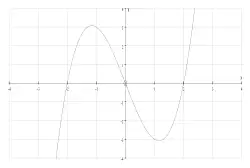
| Scheme | Marks |
|---|---|
Shape  (2 turning points required) (2 turning points required) | B1 |
| Through (or touching) origin | B1 |
| Crossing \(x\)-axis or “stopping at \(x\)-axis” (not a turning point) at \((-2, 0)\) and \((2, 0)\). | B1 |
| Allow \(-2\) and 2 on \(x\)-axis. Also allow \((0, -2)\) and \((0, 2)\) if marked on \(x\)-axis. Ignore extra intersections with \(x\)-axis. | |
| (3) |
Notes
The 2nd and 3rd B marks are not dependent upon the 1st B mark, but are dependent upon a sketch having been attempted.
| Scheme | Marks |
|---|---|
| Either \(\ y = 3\) (at \(x = -1\)) or \(\ y = 15\) (at \(x = 3\)) Allow if seen elsewhere. | B1 |
| Gradient \(= \dfrac{\text{"}15 - 3\text{"}}{3 - (-1)}\ (= 3)\) Attempt correct grad. formula with their \(y\) values. For gradient M mark, if correct formula not seen, allow one slip, e.g. \(\dfrac{\text{"}15 - 3\text{"}}{3 - 1}\) | M1 |
| \(y - \text{"}15\text{"} = m(x - 3)\) or \(y - \text{"}3\text{"} = m(x - (-1))\), with any value for \(m\). | M1 |
| \(y - 15 = 3(x - 3)\) or the correct equation in any form, e.g. \(y - 3 = \dfrac{15 - 3}{3 - (-1)}(x - (-1)),\ \ \dfrac{y - 3}{x + 1} = \dfrac{15 - 3}{3 + 1}\) | A1 |
| \(y = 3x + 6\) | A1 |
| (5) |
Notes
1st M: May be implicit in the equation of the line, e.g. \(\dfrac{y - \text{"}15\text{"}}{3 - \text{"}15\text{"}} = \dfrac{x - \text{"}3\text{"}}{-1 - \text{"}3\text{"}}\)
2nd M: An equation of a line through \((3, \text{"}15\text{"})\) or \((-1, \text{"}3\text{"})\) in any form, with any gradient (except 0 or \(\infty\)).
2nd M: Alternative is to use one of the points in \(y = mx + c\) to find a value for \(c\), in which case \(y = 3x + c\) leading to \(c = 6\) is sufficient for both A marks.
1st A1: Correct equation in any form.
| Scheme | Marks |
|---|---|
| \(AB = \sqrt{\left(\text{"}15 - 3\text{"}\right)^2 + \left(3 - (-1)\right)^2}\) (With their non-zero \(y\) values)... Square root is required. | M1 |
| \(= \sqrt{160}\ \left(= \sqrt{16}\sqrt{10}\right) = 4\sqrt{10}\) (Ignore \(\pm\) if seen) (\(\sqrt{16}\sqrt{10}\) need not be seen). | A1 |
| (2) | |
| (13 marks) |