
C1 January 2013 Q10
10.\[4x^2 + 8x + 3 \equiv a(x + b)^2 + c\]
| Scheme | Marks |
|---|---|
| This may be done by completion of square or by expansion and comparing coefficients | |
| \(a = 4\) | B1 |
| \(b = 1\) | B1 |
| All three of \(a = 4\), \(b = 1\) and \(c = -1\) | B1 |
| (3) |
Notes
B1: States \(a = 4\) or obtains \(4(x + b)^2 + c\),
B1: States \(b = 1\) or obtains \(a(x + 1)^2 + c\),
B1: States \(a = 4\), \(b = 1\) and \(c = -1\) or \(4(x + 1)^2 - 1\) (Needs all 3 correct for final mark)
Special cases: If answer is left as \((2x + 2)^2 - 1\) treat as misread B1B0B0
or as \(2(x + 1)^2 - 1\) then the mark is B0B1B0 from scheme
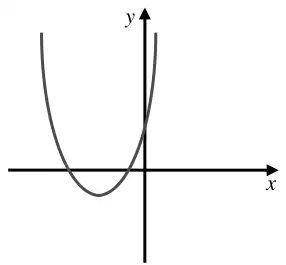
| Scheme | Marks |
|---|---|
| U shaped quadratic graph. | M1 |
| The curve is correctly positioned with the minimum in the third quadrant. . It crosses \(x\) axis twice on negative \(x\) axis and \(y\) axis once on positive \(y\) axis. | A1 |
| Curve cuts \(y\)-axis at \((\{0\}, 3)\) only | B1 |
| Curve cuts \(x\)-axis at \(\left(-\tfrac{3}{2}, \{0\}\right)\) and \(\left(-\tfrac{1}{2}, \{0\}\right)\). | B1 |
| (4) | |
| (7 marks) |
Notes
M1: Any position provided U shaped (be generous in interpretation of U shape but V shape is M0)
A1: The curve is correctly positioned with the minimum in the third quadrant. It crosses \(x\) axis twice on negative \(x\) axis and \(y\) axis once on positive \(y\) axis.
B1: Allow 3 on \(y\) axis and allow either \(y = 3\) or \((0, 3)\) if given in text Curve does not need to pass through this point and this mark may be given even if there is no curve at all or if it is drawn as a line.
B1: Allow −3/2 and −1/2 if given on \(x\) axis – need co-ordinates if given in text or \(x = -3/2\), \(x = -1/2\) . Accept decimal equivalents. Curve does not need to pass through these points and this mark may be given even if there is no curve. Ignore third point of intersection and allow touching instead of cutting. So even a cubic curve might get M0A0 B1 B1.
A V shape with two ruled lines for example might get M0A0B1B1