
C1 June 2011 Q10
10. The curve \(C\) has equation\[y = (x + 1)(x + 3)^2\]
The point \(A\), with \(x\)-coordinate \(-5\), lies on \(C\).
Another point \(B\) also lies on \(C\). The tangents to \(C\) at \(A\) and \(B\) are parallel.
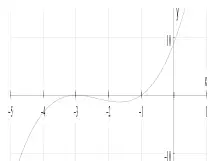
| Scheme | Marks |
|---|---|
| Shape (cubic in this orientation) | B1 |
| Touching \(x\)-axis at \(\mathbf{-3}\) | B1 |
| Crossing at \(\mathbf{-1}\) on \(x\)-axis | B1 |
| Intersection at 9 on \(y\)-axis | B1 |
| (4) |
Notes
(a) Crossing at \(-3\) is B0. Touching at \(-1\) is B0
| Scheme | Marks |
|---|---|
| \(y = (x + 1)(x^2 + 6x + 9) = x^3 + 7x^2 + 15x + 9\) or equiv. (possibly unsimplified) | B1 |
| Differentiates their polynomial correctly – may be unsimplified | M1 |
| \(\dfrac{\mathrm{d}y}{\mathrm{d}x} = 3x^2 + 14x + 15 \qquad (*)\) | A1 cso |
| (3) |
Notes
(b) M: This needs to be correct differentiation here
A1: Fully correct simplified answer.
| Scheme | Marks |
|---|---|
| At \(x = -5\): \(\dfrac{\mathrm{d}y}{\mathrm{d}x} = 75 - 70 + 15 = 20\) | B1 |
| At \(x = -5\): \(y = -16\) | B1 |
| \(y - (\text{"}-16\text{"}) = \text{"}20\text{"}(x - (-5))\) or \(y = \text{“}20x\text{”} + c\) with \((-5, -\text{“}16\text{”})\) used to find \(c\) | M1 |
| \(y = 20x + 84\) | A1 |
| (4) |
Notes
(c) M: If the \(-5\) and “\(-16\)” are the wrong way round or – omitted the M mark can still be given if a correct formula is seen, (e.g. \(y - y_1 = m(x - x_1)\)) otherwise M0.
\(m\) should be numerical and not 0 or infinity and should not have involved negative reciprocal.
| Scheme | Marks |
|---|---|
| Parallel: \(3x^2 + 14x + 15 = \text{"}20\text{"}\) | M1 |
| \((3x - 1)(x + 5) = 0 \qquad x = \ldots\) | M1 |
| \(x = \dfrac{1}{3}\) | A1 |
| (3) | |
| (14 marks) |
Notes
(d) 1st M: Putting the derivative expression equal to their value for gradient
2nd M: Attempt to solve quadratic (see notes) This may be implied by correct answer.