
C1 June 2007 Q5
5.
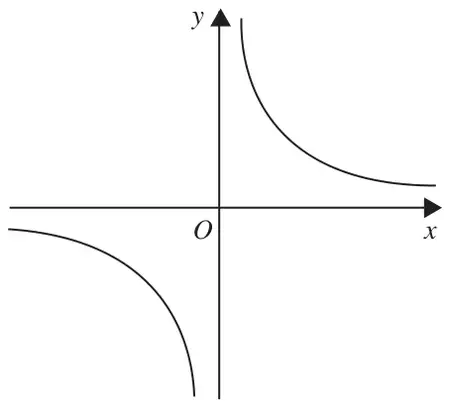
Figure 1 shows a sketch of the curve with equation \(y = \dfrac{3}{x}\), \(x \neq 0\).
showing the coordinates of any point at which the curve crosses a coordinate axis. (3)
| Scheme | Marks |
|---|---|
| Translation parallel to \(x\)-axis | M1 |
| Top branch intersects +ve \(y\)-axis Lower branch has no intersections No obvious overlap | A1 |
| \(\left(0, \dfrac{3}{2}\right)\) or \(\dfrac{3}{2}\) marked on \(y\)-axis | B1 |
| (3) |
Notes
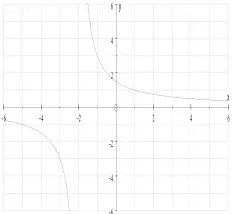
M1: for a horizontal translation – two branches with one branch cutting \(y\)-axis only.
If one of the branches cuts both axes (translation up and across) this is M0.
A1: for a horizontal translation to left. Ignore any figures on axes for this mark.
B1: for correct intersection on positive \(y\)-axis. More than 1 intersection is B0.
\(x = 0\) and \(y = 1.5\) in a table alone is insufficient unless intersection of their sketch is with +ve \(y\)-axis.
A point marked on the graph overrides a point given elsewhere.
| Scheme | Marks |
|---|---|
| \(x = -2,\quad y = 0\) | B1, B1 |
| S.C. [Allow ft on first B1 for \(x = 2\) when translated “the wrong way” but must be compatible with their sketch.] | |
| (2) | |
| (5 marks) |
Notes
1st B1: for \(x = -2\). NB \(x \neq -2\) is B0.
Can accept \(x = +2\) if this is compatible with their sketch.
Usually they will have M1A0 in part (a) (and usually B0 too)
2nd B1: for \(y = 0\).
S.C.: If \(x = -2\) and \(y = 0\) and some other asymptotes are also given award B1B0
The asymptote equations should be clearly stated in part (b). Simply marking \(x = -2\) or \(y = 0\) on the sketch is insufficient unless they are clearly marked “asymptote \(x = -2\)” etc.