June 2023 Paper 1 Q9
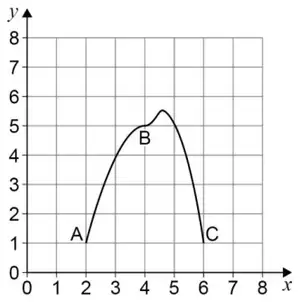
9 A continuous curve has equation \(y = \mathrm{f}(x)\)
The curve passes through the points \(A(2, 1)\), \(B(4, 5)\) and \(C(6, 1)\)
It is given that \(\mathrm{f}^{\prime}(4) = 0\)
Jasmin made two statements about the nature of the curve \(y = \mathrm{f}(x)\) at the point \(B\):
Statement 1: There is a turning point at \(B\)
Statement 2: There is a maximum point at \(B\)
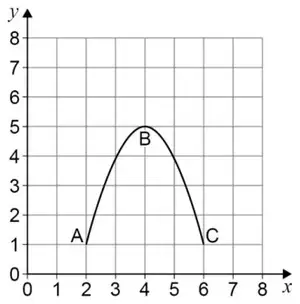
(a) Draw a sketch of the curve \(y = \mathrm{f}(x)\) such that Statement 1 is correct and Statement 2 is correct. [1 mark]
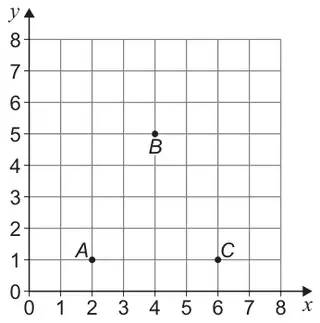
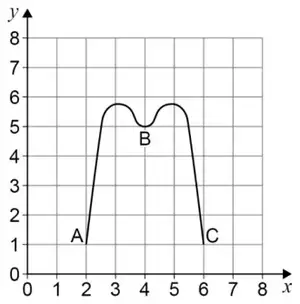
(b) Draw a sketch of the curve \(y = \mathrm{f}(x)\) such that Statement 1 is correct and Statement 2 is not correct. [1 mark]
(c) Draw a sketch of the curve \(y = \mathrm{f}(x)\) such that Statement 1 is not correct and Statement 2 is not correct. [1 mark]
| Scheme | Marks | AO |
|---|---|---|
| Draws a graph through the given points with a maximum at (4, 5) | B1 | 1.1b |
| (1) |
Typical solution
| Scheme | Marks | AO |
|---|---|---|
| Draws a graph through the given points with a minimum at (4, 5) | B1 | 2.2b |
| (1) |
Typical solution
| Scheme | Marks | AO |
|---|---|---|
| Draws a graph through the given points with a stationary point at (4, 5) that is neither a maximum nor a minimum. | B1 | 2.2b |
| (1) | ||
| (3 marks) |
Typical solution