
June 2018 Mechanics Q7
7. A train travels along a straight horizontal track between two stations, \(A\) and \(B\).
In a model of the motion, the train starts from rest at \(A\) and moves with constant acceleration 0.3 m s−2 for 80 s.
The train then moves at constant velocity before it moves with a constant deceleration of 0.5 m s−2, coming to rest at \(B\).
The total distance between the two stations is 4800 m.
| Scheme | Marks | AO |
|---|---|---|
| (i) 24 (m s−1) | B1 | 1.1b |
| (ii) 48 (s) | B1 | 1.1b |
(iii) 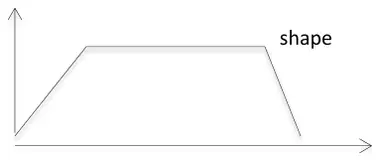 | B1 | 1.1b |
| (3) |
Notes
(i) B1: 24 (m s−1) Must be stated i.e. not just inserted on the graph
(ii) B1: 48 (s) (Allow −48 changed to 48) Must be stated i.e. not just inserted on the graph
(iii) B1: A trapezium starting at the origin and ending on the \(t\)-axis.
| Scheme | Marks | AO |
|---|---|---|
| Equating area under graph to 4800 to give equation in one unknown | M1 | 3.1b |
| \(\dfrac{1}{2}(T + T + 80 + 48) \times 24 = 4800\) OR \(\left(\dfrac{1}{2} \times 80 \times 24\right) + 24T + \left(\dfrac{1}{2} \times 48 \times 24\right) = 4800\) oe | A1ft | 1.1b |
| \(T = 136\) so total time is 264 (s) | A1 | 1.1b |
| (3) |
Notes
M1: Complete method to find area of trapezium using trapezium rule with correct structure or using two triangles and a rectangle and equate to 4800 to give equation in one unknown
N.B. \(\dfrac{1}{2}(T + 80 + 48) \times 24 = 4800\) is M0 (equivalent to using three triangles)
OR they may use suvat on one or more sections (must have \(a = 0\) for middle section) and equate total distance travelled to 4800 to give equation in one unknown
A1ft: For a correct equation in their unknown ft on their 24 and 48 (but must be positive times)
A1: For 264 (s)
| Scheme | Marks | AO |
|---|---|---|
| Accept Either: a smooth change from acceleration to constant velocity or from constant velocity to deceleration. Or have train accelerating and/or decelerating at a variable rate Do not accept e.g. Comments on air resistance or resistive forces, straightness of track, horizontal track, friction, length of train, mass of train, not having train moving with constant velocity. B0 if either an incorrect extra is included or an incorrect reason for a valid improvement is included. N.B. Variable acceleration due to air resistance is B0 BUT Variable acceleration due to variable air resistance is B1 | B1 | 3.5c |
| (1) | ||
| (7 marks) |
Notes
B1: Either: Include time to change from constant accln to constant velocity and/or time to change from constant velocity to constant deceleration oe
Or: Have train accelerating and/or decelerating at a variable rate