
October 2020 Paper 1 Q9
9.
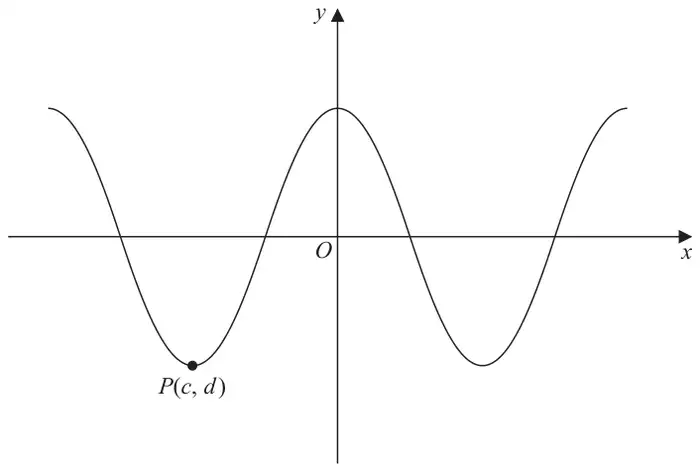
Figure 3 shows part of the curve with equation \(y = 3\cos x^\circ\).
The point \(P(c, d)\) is a minimum point on the curve with \(c\) being the smallest negative value of \(x\) at which a minimum occurs.
In part (c) you must show all stages of your working.
Solutions relying entirely on calculator technology are not acceptable. (5)
| Scheme | Marks | AO |
|---|---|---|
| \((-180^\circ, -3)\) | B1 | 1.1b |
| (1) |
Notes
B1: Deduces that \(P(-180^\circ, -3)\) or \(c = -180^{(\mathrm{o})}, d = -3\)
| Scheme | Marks | AO |
|---|---|---|
| (i) \((-720^\circ, -3)\) | B1ft | 2.2a |
| (ii) \((-144^\circ, -3)\) | B1 ft | 2.2a |
| (2) |
Notes
(b)(i)
B1ft: Deduces that \(P^{\prime}(-720^\circ, -3)\) Follow through on their \((c, d) \to (4c, d)\) where \(d\) is negative
(b)(ii)
B1ft: Deduces that \(P^{\prime}(-144^\circ, -3)\) Follow through on their \((c, d) \to (c + 36^\circ, d)\) where \(d\) is negative
| Scheme | Marks | AO |
|---|---|---|
| Attempts to use both \(\tan\theta = \dfrac{\sin\theta}{\cos\theta}\), \(\sin^2\theta + \cos^2\theta = 1\) and solves a quadratic equation in \(\sin\theta\) to find at least one value of \(\theta\) | M1 | 3.1a |
| \(3\cos\theta = 8\tan\theta \Rightarrow 3\cos^2\theta = 8\sin\theta\) | B1 | 1.1b |
| \(3\sin^2\theta + 8\sin\theta - 3 = 0\) \((3\sin\theta - 1)(\sin\theta + 3) = 0\) | M1 | 1.1b |
| \(\sin\theta = \dfrac{1}{3}\) | A1 | 2.2a |
| awrt \(520.5^\circ\) only | A1 | 2.1 |
| (5) | ||
| (8 marks) |
Notes
M1: An overall problem solving mark, condoning slips, for an attempt to
- use \(\tan\theta = \dfrac{\sin\theta}{\cos\theta}\),
- use \(\pm\sin^2\theta \pm \cos^2\theta = \pm 1\)
- find at least one value of \(\theta\) from a quadratic equation in \(\sin\theta\)
B1: Uses the correct identity and multiplies across to give \(3\cos\theta = 8\tan\theta \Rightarrow 3\cos^2\theta = 8\sin\theta\) oe
M1: Uses the correct identity \(\sin^2\theta + \cos^2\theta = 1\) to form a 3TQ in \(\sin\theta\) which they attempt to solve using an appropriate method. It is OK to use a calculator to solve this
A1: \(\sin\theta = \dfrac{1}{3}\) Accept sight of \(\dfrac{1}{3}\). Ignore any reference to the other root even if it is "used"
A1: Full method with all identities correct leading to the answer of awrt \(520.5^\circ\) and no other values.