
June 2018 Paper 1 Q6
6.
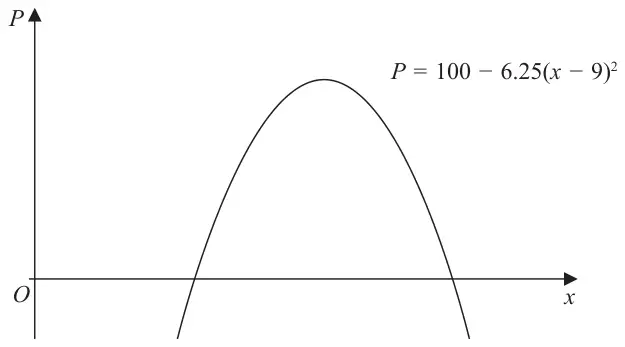
A company makes a particular type of children’s toy.
The annual profit made by the company is modelled by the equation
\[P = 100 - 6.25(x - 9)^2\]where \(P\) is the profit measured in thousands of pounds and \(x\) is the selling price of the toy in pounds.
A sketch of \(P\) against \(x\) is shown in Figure 1.
Using the model,
Given that the company made an annual profit of more than £80 000
The company wishes to maximise its annual profit.
State, according to the model,
| Scheme | Marks | AO |
|---|---|---|
| Attempts \(P = 100 - 6.25(15 - 9)^2\) | M1 | 3.4 |
| \(= -125\ \therefore\) not sensible as the company would make a loss | A1 | 2.4 |
| (2) |
Notes
M1: Substitutes \(x = 15\) into \(P = 100 - 6.25(x - 9)^2\) and attempts to calculate. This is implied by an answer of \(-125\). Some candidates may have attempted to multiply out the brackets before they substitute in the \(x = 15\). This is acceptable as long as the function obtained is quadratic. There must be a calculation seen or implied by the value of \(-125\).
A1: Finds \(P = -125\) or states that \(P \lt 0\) and explains that (this is not sensible as) the company would make a loss.
Condone \(P = -125\) followed by an explanation that it is not sensible as the company would make a loss of £125 rather than £125 000. (They will lose marks later in the question). An explanation that it is not sensible as "the profit cannot be negative" , "the profit is negative" or "the company will not make any money" , "they might make a loss" is incomplete/incorrect. You may ignore any misconceptions or reference to the price of the toy being too cheap for this mark.
Alt: M1: Sets \(P = 0\) and finds \(x = 5, 13\) A1: States \(15 \gt 13\) and states makes a loss
| Scheme | Marks | AO |
|---|---|---|
| Uses \(P \gt 80 \Rightarrow (x - 9)^2 \lt 3.2\) or \(P = 80 \Rightarrow (x - 9)^2 = 3.2\) | M1 | 3.1b |
| \(\Rightarrow 9 - \sqrt{3.2} \lt x \lt 9 + \sqrt{3.2}\) | dM1 | 1.1b |
| Minimum Price = £7.22 | A1 | 3.2a |
| (3) |
Notes
M1: Uses \(P \ldots 80\) where … is any inequality or " = " in \(P = 100 - 6.25(x - 9)^2\) and proceeds to \((x - 9)^2 \ldots k\) where \(k \gt 0\) and … is any inequality or " = "
Eg. Condone \(P \lt 80\) in \(P = 100 - 6.25(x - 9)^2 \Rightarrow (x - 9)^2 \lt k\) where \(k \gt 0\) If the candidate attempts to multiply out then allow when they achieve a form \(ax^2 + bx + c = 0\)
dM1: Award for solving to find the two positive values for \(x\). Allow decimal answers
FYI correct answers are \(\Rightarrow 9 - \sqrt{3.2} \lt x \lt 9 + \sqrt{3.2}\) Accept \(\Rightarrow x = 9 \pm \sqrt{3.2}\)
Condone incorrect inequality work \(100 - 6.25(x - 9)^2 \gt 80 \Rightarrow (x - 9)^2 \gt 3.2 \Rightarrow x \gt 9 \pm \sqrt{3.2}\)
Alternatively award if the candidate selects the lower of their two positive values \(9 - \sqrt{3.2}\)
A1: Deduces that the minimum Price = £7.22 (£7.21 is not acceptable)
Trial and improvement or just answers of £7.22 or £7.21(with no working) then please send to review.
| Scheme | Marks | AO |
|---|---|---|
| States (i) maximum profit = £ 100 000 and (ii) selling price £9 | B1 B1 | 3.2a 2.2a |
| (2) | ||
| (7 marks) |
Notes
(i) B1: Maximum Profit = £ 100 000 with units. Accept 100 thousand pound.
(ii) B1: Selling price = £9 with units
SC 1: Missing units in (b) and (c) only penalise once, withhold the final mark. Eg correct values in (c) would be scored B1 B0.
SC 2: If the answers to (c) are both correct, but in the wrong order score SC B1 B0
If (i) and (ii) are not written out score in the order given.