
June 2025 Paper 1 Q2
2. The line \(l\) passes through the points \(A(-3,\ 0)\) and \(B\left(\dfrac{5}{2},\ 22\right)\)
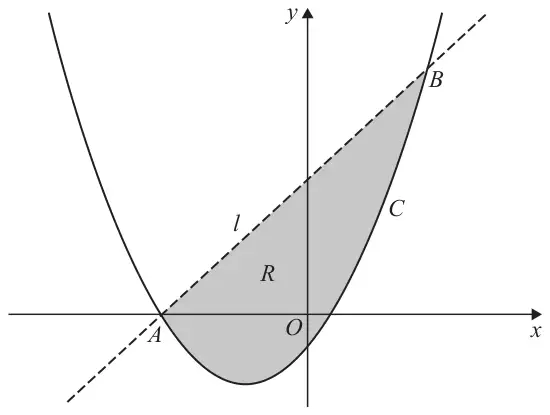
Figure 2 shows the line \(l\) and the curve \(C\), which intersect at \(A\) and \(B\).
Given that
- \(C\) has equation \(y = 2x^2 + 5x - 3\)
- the region \(R\), shown shaded in Figure 2, is bounded by \(l\) and \(C\)
| Scheme | Marks | AO |
|---|---|---|
| \(A(-3,0)\) and \(B(2.5,\ 22)\) | ||
| \(m = \dfrac{22-0}{2.5--3} = \dfrac{22}{5.5}\{=4\}\) | M1 | 1.1b |
| \(y - 22 = \text{``}4\text{''}(x - 2.5)\) or \(y - 0 = \text{``}4\text{''}(x - -3)\) or \(0 = \text{``}4\text{''} \times -3 + c \Rightarrow c = \ldots\) or \(22 = \text{``}4\text{''} \times 2.5 + c \Rightarrow c = \ldots\) | dM1 | 1.1b |
| \(y = 4x + 12\) | A1 | 1.1b |
| (3) |
Notes
M1: Attempts Gradient \(= \dfrac{22-0}{2.5--3}\).
Condone 1 sign/copying slip only if a correct formula is seen or implied e.g. \(\dfrac{y_2 - y_1}{x_2 - x_1}\)
Alternatively solves two simultaneous equations, e.g. \(22 = \dfrac{5}{2}m + c\) and \(0 = -3m + c\) to find a value for \(m\) or \(c\).
dM1: Uses \(y - y_1 = m(x - x_1)\) with either \(A(-3,0)\) or \(B(2.5,\ 22)\) or e.g. \(\left(-\dfrac{1}{4},\ 11\right)\) (midpoint) and their \(m = \text{``}4\text{''}\) with the values correctly placed.
If \(y = mx + c\) is used they must proceed as far as \(c = \ldots\)
Alternatively solves two simultaneous equations, e.g. \(22 = \dfrac{5}{2}m + c\) and \(0 = -3m + c\) to find \(m\) and \(c\).
A1: \(y = 4x + 12\) or \(y = 12 + 4x\) only.
If they use e.g. \(\dfrac{y}{22-0} = \dfrac{x+3}{2.5--3}\) both M’s can be scored together.
Condone 1 sign/copying slip only if a correct formula is seen or implied.
Correct answer only scores full marks.
| Scheme | Marks | AO |
|---|---|---|
| \(y \lt 4x + 12\) \(y \geqslant 2x^2 + 5x - 3\) | B1ft | 2.2a |
| \(2x^2 + 5x - 3 \leqslant y \lt 4x + 12\) | B1ft | 1.1b |
| (2) | ||
| (5 marks) |
Notes
B1ft: Deduces one of \(y \lt \text{``}4x+12\text{''}\) o.e. or \(y \geqslant 2x^2 + 5x - 3\) o.e.
They must have an equation for \(l\) and it must be the equation of a straight line.
B1ft: \(y \lt \text{``}4x+12\text{''}\) and \(y \geqslant 2x^2 + 5x - 3\)
o.e. e.g. \(2x^2 + 5x - 3 \leqslant y \lt \text{``}4x+12\text{''}\), or \(y \lt \text{``}4x+12\text{''},\ y \geqslant 2x^2 + 5x - 3\)
Note: For what is an otherwise correctly defined region, if there are any extra inequalities that are contradictory e.g. \(-3 \lt x \lt 0\) then withhold the second B mark but note that \(-3 \leqslant x \leqslant \frac{5}{2}\) or anything “wider” is fine. (Do not be concerned about strictness)
Condone the use of “or” or “\(\cup\)” for the first B mark but \(y \lt \text{``}4x+12\text{''}\) or \(y \geqslant 2x^2 + 5x - 3\) or \(y \lt \text{``}4x+12\text{''} \cup y \geqslant 2x^2 + 5x - 3\) scores B1B0
They must have an equation for \(l\) and it must be the equation of a straight line.
Note: Apply isw if the correct inequalities are written separately but are then combined incorrectly.
Note: Inequalities cannot be in terms of \(R\) e.g. \(2x^2 + 5x - 3 \leqslant R \lt \text{``}4x+12\text{''}\)
Alternatively, some candidates may express their inequalities involving a boundary for a dashed line with \(\leqslant\) or \(\geqslant\) and a boundary for a solid line with \(\lt\) or \(\gt\).
It may not always be clear so mark positively.
e.g.
B1ft: Deduces one of \(y \leqslant \text{``}4x+12\text{''}\) o.e. or \(y \gt 2x^2 + 5x - 3\) o.e.
They must have an equation for \(l\) and it must be the equation of a straight line.
B1ft: \(y \leqslant \text{``}4x+12\text{''}\) and \(y \gt 2x^2 + 5x - 3\) o.e. e.g. \(2x^2 + 5x - 3 \lt y \leqslant \text{``}4x+12\text{''}\)
They must have an equation for \(l\) and it must be the equation of a straight line.
In general look at the direction for the first mark to see if one inequality has the correct direction. Then for the second B mark they need correct direction and consistent ‘strict’ or ‘non-strictness’ with the other inequality.
So e.g. \(y \lt \text{``}4x+12\text{''},\ y \gt 2x^2 + 5x - 3\) scores B1B0
Note that some candidates define \(R\) as \(-3 \lt x \lt \dfrac{5}{2}\) and this scores no marks on its own.