
Numeracy Intermediate November 2023 Unit 2 Q6
6. Glanafon and Pencwm dog rescue centres take in unwanted dogs.
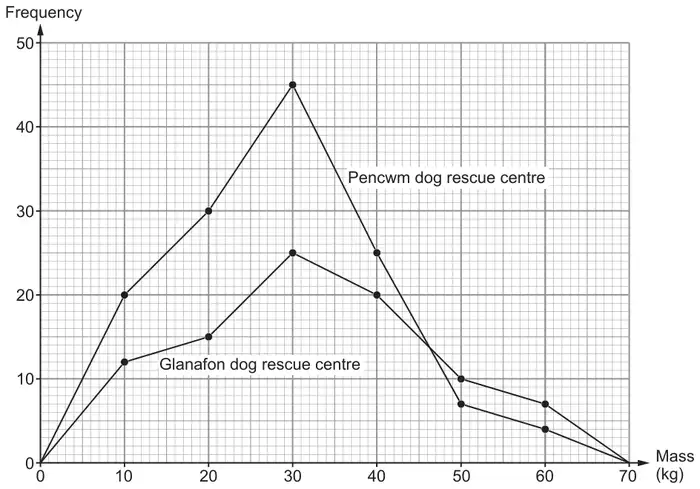
The mass of each dog in the two dog rescue centres was recorded.
Groups of width 10 kg were used:
\(5\text{ kg} \leqslant \text{mass} \lt 15\text{ kg}\), \(15\text{ kg} \leqslant \text{mass} \lt 25\text{ kg}\), …, \(55\text{ kg} \leqslant \text{mass} \lt 65\text{ kg}\)
The results are shown in the frequency polygons below.
Doreen, Rory and Muzhir look at these frequency polygons.
“The modal group of the masses of dogs in each dog rescue centre is the same.”
Is Doreen correct?
Yes ☐ No ☐ Can’t tell ☐
You must give a reason for your answer. [1]
“28 of the dogs in Pencwm each have a mass of 18 kg.”
Is Rory correct?
Yes ☐ No ☐ Can’t tell ☐
You must give a reason for your answer. [1]
“There is a higher proportion of dogs that are heavier than 35 kg in Glanafon than in Pencwm.”
Without doing any calculations, decide if Muzhir is correct.
Correct ☐ Incorrect ☐ Can’t tell ☐
You must give a reason for your answer. [1]
How much less was the estimate of the mean mass of the dogs in Pencwm?
You must show all your working. [5]
Estimate of the mean mass of the dogs in Pencwm is …………… kg less than in Glanafon.
| Scheme | Marks | Comments |
|---|---|---|
| (i) Unambiguously indicates or states ‘Yes’ with a reason, e.g. ‘both 25 kg to 35 kg’, ‘the highest frequencies at the same mass’ | E1 | Ignore any additional spurious or contradictory statements provided ‘Yes’ selected Allow ‘Yes’ with a reason, e.g. ‘both at 30 kg’, ‘both at the same mass’, ‘both have the same mass’, ‘tallest (highest frequency) is 30 kg for both polygons’ Do not accept ‘Yes’ with a reason, e.g. ‘don’t know’, ‘both in the same place’, ‘the groups have the same width’, ‘the graph tells us this’ |
| (ii) Unambiguously indicates or states ‘Can’t tell’ with a reason, e.g. ‘there were 30 dogs with a masses between 15 kg and 25 kg’, ‘no raw data is given’, ‘the actual mass of each dog is not given’, ‘the data is grouped’ | E1 | Ignore any additional spurious or contradictory statements provided ‘Can’t tell’ selected Allow ‘Can’t tell’ with a reason, e.g. ‘doesn’t show this’, ‘you can’t tell the exact number of dogs’ ‘doesn’t give the amount of dogs’ Do not accept ‘Can’t tell’ with a reason, e.g. ‘don’t know’, ‘it is an estimate’, ‘it isn’t accurate’, ‘because they can be anywhere from 10 kg to 20 kg’ |
| (iii) Unambiguously indicates or states ‘Correct’ with a reason, e.g. ‘Pencwm polygon shows a greater drop for greater masses’, ‘fewer dogs but more large dogs in Glanafon’, ‘more dogs in Pencwm, but fewer large dogs’, ‘about the same number of large dogs, with fewer dogs in Glanafon’, ‘about the same number of large dogs, with more dogs in Pencwm’, | E1 | Ignore any additional spurious or contradictory statements provided ‘Correct’ selected Do not allow a reason based on calculations of proportions alone, e.g. Pencwm 27.5%, Glanafon 41.6% Allow ‘Correct’ with a reason, e.g. ‘Pencwm (polygon) shows a steeper drop from 30 kg’, ‘line for Pencwm is steeper (drop)’, ‘Glanafon (polygon) has a less steep drop for larger dogs’, ‘the greater masses are more frequent (in Glanafon)’ ‘2 of the 3 points for Glanafon are above Pencwm’, ‘Pencwm line drops below Glanafon after 40 (kg)’ Do not accept ‘Correct’ with a reason, e.g. ‘36 dogs in Pencwm and 37 dogs in Glanafon’ alone without considering proportion, ‘the greatest is 45 kg’, ‘higher frequency in Glanafon’, ‘Pencwm is bigger but doesn’t have higher proportion’ ‘as seen by the skew in (the) Glanafon (polygon)’, ‘seen by the shape (of the polygon) for Glanafon’ |
| Scheme | Marks | Comments |
|---|---|---|
| (Total number of dogs 20 + 30 + 45 + 25 + 7 + 4 =) 131 | B1 | May be implied by the sight of ((20 + 30 + 45 + 25 + 7 + 4) ÷ 6 =) 21.8(33...) |
| 10×20 + 20×30 + 30×45 + 40×25 + 50×7 + 60×4 (= 200 + 600 + 1350 + 1000 + 350 + 240) (= 3740) | M1 | Ignore any additional products seen FT ‘their midpoints’ provided at least 5 are within or at the bounds of the relevant groups e.g. use of
|
| ÷ 131 | m1 | FT an error in summing 20, 30, 45, 25, 7 and 4 |
| (28.5(496.... kg) so) 3.95 (kg) (less) | A2 | CAO ISW further rounding or truncation Allow 4 (kg) from correct working Accept (29 (kg) and) 3.5 (kg) from correct working Award A1 for any of the following as the final answer
Award A1 on FT from M1 m1 previously awarded for a correct evaluation of ‘their estimate mean’ e.g. use of lower bounds gives (3085/131 =) 23.54… |
Alternative
6(b) Alternative MS if Glanafon’s last 2 points used for possible award of B1 M1 m1 only
| Scheme | Marks | Comments |
|---|---|---|
| (Sight of 20 + 30 + 45 + 25 + 10 +7 =) 137 | B1 | May be implied by the sight of ((20 + 30 + 45 + 25 + 10 + 7) ÷ 6 =) 22.8(33...) |
| 10×20 + 20×30 + 30×45 + 40×25 + 50×10 + 60×7 (= 200 + 600 + 1350 + 1000 + 500 + 420) (= 4070) | M1 | Ignore any additional products seen FT ‘their midpoints’ provided at least 5 are within or at the bounds of the relevant groups e.g. use of
|
| ÷ 137 | m1 | FT an error in summing 20, 30, 45, 25, 10 and 7 |