
Numeracy Intermediate June 2017 Unit 2 Q8
8.
Miss Rashud gave her Year 9 French class a test on Wednesday.
She asked her class to spell 12 different words.
She displays the results as shown below.
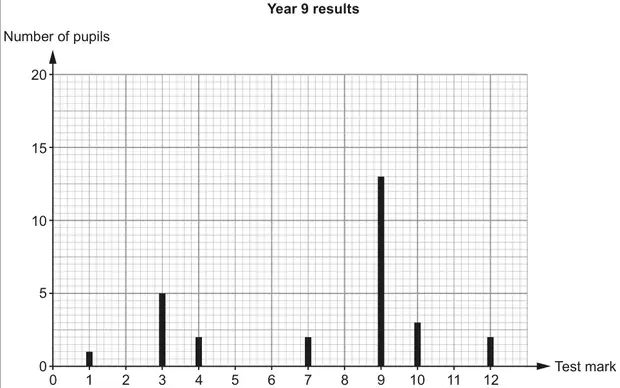
How many pupils scored more than 9 in the test? [1]
How many pupils are there in Miss Rashud’s French class? [1]
What assumption have you made in answering part (ii)? [1]
Miss Rashud also gave the same test to her Year 10 French class on Wednesday.
She asked her class to spell the same 12 words.
She displays the results as shown below.
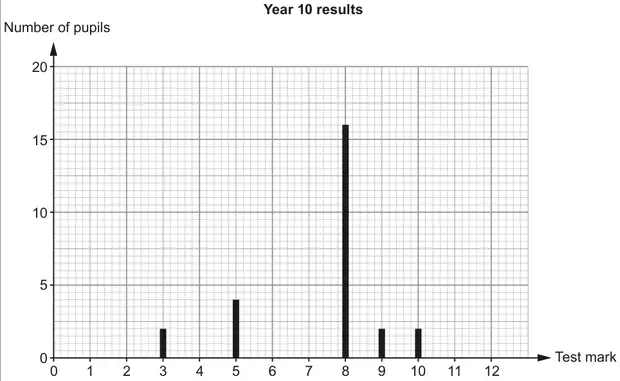
Leon says,
Without calculating the mean, explain whether Leon is correct or not. [1]
Correct ☐ Not correct ☐
Catrin looks at the two sets of data Miss Rashud has displayed.
She says,
Is Catrin’s statement correct?
You must give values to support your answer. [1]
Catrin is correct ☐ Catrin is incorrect ☐
| Scheme | Marks | Comments |
|---|---|---|
| (i) 5 | B1 | |
| (ii) (At least) 28 (pupils) | B1 | |
| (iii) Assumption stated e.g. ‘no one was absent’, ‘all pupils present on the test day’, ‘everyone in the class took the test that day’ | E1 | Needs to show understanding that the number of pupils doing the test may not be the number of pupils in the class Do not accept a description of the method, e.g. ‘adding the number of test scores gives the number of pupils’, ‘used the number of test marks’, ‘used the numbers who did the test’, UNLESS the candidate continues to state an assumption |
| Scheme | Marks | Comments |
|---|---|---|
| (i) Indicates ‘correct’ with a suitable reason e.g. ‘as 16 out of the 26 pupils all scored 8 marks’, ‘scores bunched at 8 marks’ OR Indicates 'not correct' with a suitable reason e.g. 'mean will be less than 8' | E1 | If numbers are given within a reason they must be correct Any reason given must show understanding of the majority of scores being 8 (with few other scores balanced either side) Do not accept responses based on the evaluated calculations of mean(s) (Yr9 209/28 = 7.46..., Yr10 192/26 = 7.38...) |
| (ii) Catrin ‘incorrect’ selected or unambiguously implied with a reason, e.g. ‘(18 Year 9 pupils but) only 4 Year 10 pupils scored 9 or higher’, ‘only 2 Year 10 pupils scored 10 or higher’, ‘more pupils with higher marks in Year 9’, ’18 pupils in Year 9 scored >8, compared with only 4 pupils in Year 10’ | E1 | If numbers are given within a reason they must be correct Accept a response based on the means, with mean for Year 9 as 7.46.. and Year 10 is 7.38.. If ‘incorrect’ selected or unambiguously implied, allow e.g. ‘the mode for Year 10 is 8 (marks), but the mode for Year 9 is 9 (marks)’, ‘Year 9 mode is higher at 9 (marks)’, Do not accept, e.g. ‘the highest score in Year 9 is 12, whereas only 10 in Year 10’, ‘Year 9 had 2 pupils with full marks’, ‘Some pupils in Year 9 had full marks’ Alternative: Catrin ‘correct’ with a clear reason based on the majority of higher scores, e.g. ‘Yr10 20 people scored 8 or more, Yr9 18 people scored 8 or more’ Note: Unless the mode is considered, there must be comparison of a range of marks |
Corrected by Westie's Workshop
- The board's mark scheme printed “If ‘incorrect’ selected or unambiguously, allow e.g.”. Changed to “If ‘incorrect’ selected or unambiguously implied, allow e.g.” because the word “implied” is missing (part (ii) of the scheme says “selected or unambiguously implied”).
Original: see the board's mark scheme PDF (link above).