
Intermediate November 2019 Unit 2 Q16
16. A solid object is made by drilling a cylindrical hole of radius 4 cm through a cuboid measuring 20 cm by 15 cm by 10 cm as shown below.
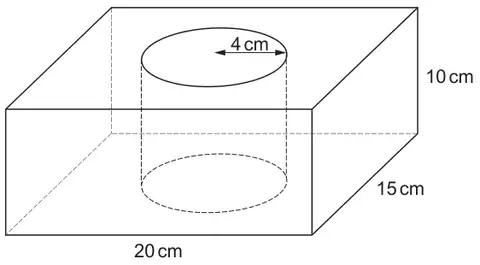
Diagram not drawn to scale
(a) Calculate the volume of the object.
Give your answer in cm3. [3]
Give your answer in cm3. [3]
Volume = ……………… cm3
(b) The object is made from a material which has a density of 2·4 g/cm3.
Calculate the mass of the object.
Give your answer in kg, correct to the nearest kg. [3]
Calculate the mass of the object.
Give your answer in kg, correct to the nearest kg. [3]
Mass = ……………… kg
| Scheme | Marks | Comments |
|---|---|---|
| 20 × 15 – π × 42 | M1 | |
| × 10 | m1 | |
| 2497(·….) OR 3000 − 160 π | A1 | Accept an answer between 2497 and 2498 inclusive OR 2500. SC1 for sight of π × 42 × 10 OR 160 π (accept 502 to 503 inclusive). |
| Scheme | Marks | Comments |
|---|---|---|
| (Mass =) 2497·(..) × 2·4 OR 2497·(..) × 0·0024 | M1 | F.T. ‘their volume in (a)’ |
| = 5993·6(..)(g) OR 5·9936..(kg) | A1 | Accept value truncated or rounded to a whole number. Ignore units. |
| 6(kg) | A1 | F.T. from ‘their 5993·6..g’ or ‘their 5·9936..kg’ ONLY if M1 awarded AND ‘their 5993·6..g’ > 500g or ‘their 5·9936..kg’ > 0.5kg If no marks awarded, allow SC1 for (Mass =) ‘their volume’ × density, where density may have incorrect place value e.g. ‘2497·(..) × 0·024’ |