
Higher November 2021 Unit 2 Q14
14. Triangle ABC is shown below.
The length of AC is \((x - 1)\) cm.
The length of BC is \((2x + 3)\) cm.
The size of \(A\hat{C}B\) is 30°.
The area of triangle ABC is 6 cm2.
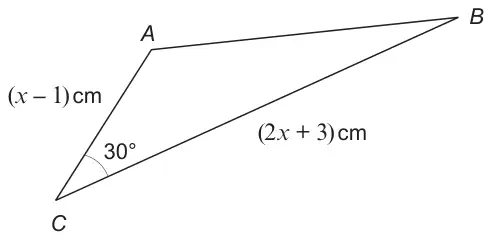
Diagram not drawn to scale
(a) Show that [3]
\[2x^2 + x - 27 = 0.\]
(b) Solve the equation
\[2x^2 + x - 27 = 0.\]
You must use an algebraic method and show all your working.
Give your answers correct to 2 decimal places. [3]
(c) Evaluate the length of AC.
You must justify any decision that you make. [2]
You must justify any decision that you make. [2]
From the formula list: In any triangle \(ABC\): Area of triangle \(= \dfrac{1}{2}ab\sin C\); The solutions of \(ax^2 + bx + c = 0\) where \(a \neq 0\) are given by \(x = \dfrac{-b \pm \sqrt{b^2 - 4ac}}{2a}\)
| Scheme | Marks | Comments |
|---|---|---|
| \(\tfrac{1}{2} \times (x - 1) \times (2x + 3) \times \sin 30^\circ\ [= 6]\) OR \(\tfrac{1}{2} \times (2x^2 + 3x - 2x - 3) \times \sin 30^\circ\ [= 6]\) | B1 | Use of ‘Area = ½ ab sinC’. |
| \(2x^2 + x - 3\ (= 6 \times 2 \times 2)\) | B1 | Correct expansion of brackets and correct collection of \(x\) terms. May be implied within equation. |
| \(2x^2 + x - 27 = 0\) | B1 | Must be convincing. |
| Scheme | Marks | Comments |
|---|---|---|
| \((x =)\ \dfrac{-1 \pm \sqrt{[(1)^2 - 4(2)(-27)]}}{2(2)}\) | M1 | This substitution into the formula must be seen for M1, otherwise award M0A0A0. Allow one slip in substitution for M1 only, but must be correct formula. |
| \((x =)\ \dfrac{-1 \pm \sqrt{217}}{4}\) | A1 | Can be implied from at least one correct value of \(x\) evaluated, provided M1 awarded. |
| \((x =)\ -3{\cdot}93\) AND \(3{\cdot}43\) | A1 | Both solutions required. Using trial and improvement Award B3 for a method leading to both solutions, namely \(x = -3{\cdot}93\) AND \(x = 3{\cdot}43\), otherwise B0. An unsupported answer gains zero marks. |
| Scheme | Marks | Comments |
|---|---|---|
| (AC =) 2·43 (cm) | B1 | F.T. ‘their derived \(x\)’ provided one positive and one negative solution. |
| Length cannot be negative / must be positive. | E1 | Accept any valid explanation, e.g. \(x - 1 \gt 0\), so \(x \gt 1\), \(x\) cannot be negative (as \(x - 1\) must be > 0) |