
Foundation June 2023 Unit 1 Q18
18. Two fair spinners are shown below.
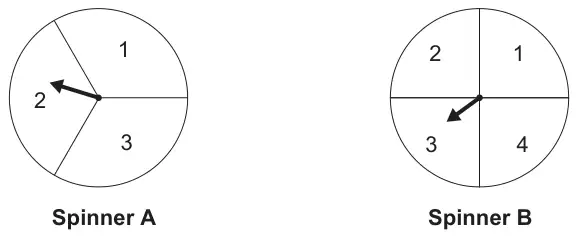
In a game, the numbers shown by the two pointers are added together.
In the diagram, the score gained would be 2 + 3 = 5.
A winning score is 6 or more.
How many winning scores would you expect when the game is played 60 times?
You must show all your working. [5]
| Scheme | Marks | Comments | ||||||
|---|---|---|---|---|---|---|---|---|
| Identifying 12 possible combinations | B1 | Award B1 for convincing identification of the 12 combinations, for example:
| ||||||
| Identifying the 3 correct combinations that give a score of 6 or more (2 and 4, 3 and 3, 3 and 4) | B1 | Strict FT only if a list of all possible scores previously stated. | ||||||
| (Probability of ‘6 or more’ =) \(\dfrac{3}{12}\) or equivalent ISW ( but note comment for M1 below) | B1 | A fraction with a denominator of 12 implies the first B1. Unsupported \(\dfrac{3}{12}\) or equivalent implies previous B1B1. Probability may be implied in later working (e.g. 60 ÷ 12 = 5, 5 × 3 = 15). FT if a clear numerator and denominator can be identified from previous work.
| ||||||
| (Number of winning scores =) \(\dfrac{3}{12}\) × 60 or equivalent | M1 | FT ‘their \(\dfrac{3}{12}\)’ If ‘their \(\dfrac{3}{12}\)’ incorrectly simplified and used then award B0 previously. | ||||||
| = 15 | A1 | Must not come from incorrect working. Award M1 A0 for a final answer of ( \(\dfrac{3}{12}\) =) \(\dfrac{15}{60}\) Note: using ‘a winning score of 6’ instead of ‘a winning score of 6 or more’ can be awarded a maximum of B1B0B1M1A1. |