
June 2024 Unit 4 Q9
9. The diagram below shows a parcel, of mass \(m\) kg, sliding down a rough slope inclined at an angle \(\alpha\) to the horizontal, where \(\sin\alpha=\dfrac{7}{25}\).
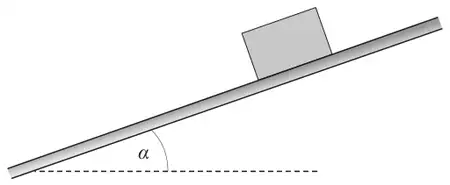
The coefficient of friction between the parcel and the slope is \(\dfrac{1}{12}\). In addition to friction, the parcel experiences a variable resistive force of \(mv\) N, where \(v\,\text{ms}^{-1}\) is the velocity of the parcel at time \(t\) seconds.
(a) Show that the motion of the parcel satisfies the differential equation \[5\frac{\mathrm{d}v}{\mathrm{d}t}=g-5v.\] [5]
(b) Given that the parcel is initially at rest on the slope, find an expression for \(v\) in terms of \(t\) and \(g\). [5]
(c) To avoid damage, the speed of the parcel must be restricted to a maximum of \(2\,\text{ms}^{-1}\) down the slope. Determine whether or not the speed of the parcel exceeds \(2\,\text{ms}^{-1}\). [1]
| Scheme | Marks | Comments |
|---|---|---|
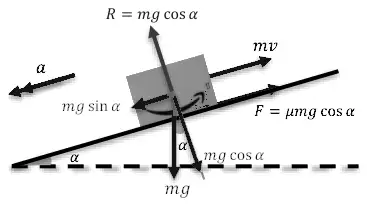
| \(\sin\alpha=\frac{7}{25}=0{\cdot}28\) \(\cos\alpha=\frac{24}{25}=0{\cdot}96\) \(\mu=\frac{1}{12}\) | ||
| \(R=mg\cos\alpha\) \(\left(=\frac{24}{25}mg\right)\) | B1 | si |
| \(F=\frac{1}{12}\times R\) \(\left(F=\frac{1}{12}\times mg\cos\alpha=\frac{1}{12}\times\frac{24}{25}mg=\frac{2}{25}mg\right)\) | B1 | si |
| Apply N2L to parcel, downwards positive \(mg\sin\alpha-F-mv=ma\) | M1 A1 | Dim. correct equation, all forces/terms |
| \(\frac{7}{25}mg-\frac{2}{25}mg-mv=ma\) \(5\dfrac{\mathrm{d}v}{\mathrm{d}t}=g-5v\) | A1 | Convincing |
| [5] |
| Scheme | Marks | Comments |
|---|---|---|
| \(\displaystyle\int\frac{5}{g-5v}\,\mathrm{d}v=\int\mathrm{d}t\) \(\displaystyle\frac{5}{-5}\int\frac{1}{g-5v}\,\mathrm{d}v=\int\mathrm{d}t\) | M1 | Separating variables |
| \(-\frac{5}{5}\ln|g-5v|=t\ \ (+C)\) | A1 | Correct integration |
| When \(t=0,\ v=0\) \(C=-\ln(g)\) | m1 | Used |
| \(-t=\ln\left|\dfrac{g-5v}{g}\right|\) \(\mathrm{e}^{-t}=1-\frac{5}{g}v\) | m1 | Attempted inversion, |
| \(v=\frac{g}{5}(1-\mathrm{e}^{-t})\) | A1 | cao, oe (in terms of \(g\)) Examples, \(v=\dfrac{g}{5}\left(1-\dfrac{1}{\mathrm{e}^t}\right)=\dfrac{g\mathrm{e}^t-g}{5\mathrm{e}^t}\) |
| [5] |
| Scheme | Marks | Comments |
|---|---|---|
Parcel will not exceed 2 with reason, e.g.
| B1 | Convincing |
| [1] | ||
| Total for Question 9 | 11 |