
June 2023 Unit 4 Q9
9. The diagram below shows a wooden crate of mass 35 kg being pushed on a rough horizontal floor, by a force of magnitude 380 N inclined at an angle of 30° below the horizontal. The crate, which may be modelled as a particle, is moving at a constant speed.
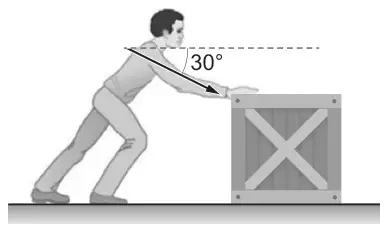
(a) The coefficient of friction between the crate and the floor is \(\mu\). Show that \[\mu=\frac{190\sqrt{3}}{533}.\] [6]
Suppose instead that the crate is pulled with the same force of 380 N inclined at an angle of 30° above the horizontal, as shown in the diagram below.
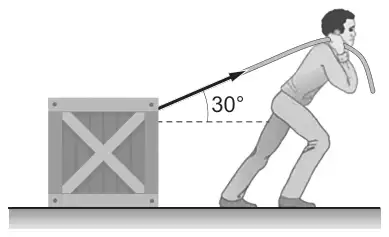
(b) Without carrying out any further calculations, explain why the crate will no longer move at a constant speed. [1]
| Scheme | Marks | Comments |
|---|---|---|
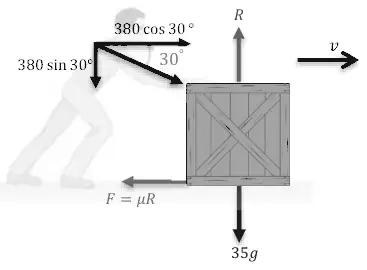
| \(R=35g+380\sin 30^\circ\) \(F=\mu R=(35g+380\sin 30^\circ)\mu\) \(35g=343\) \(380\cos 30^\circ=380\times\frac{\sqrt{3}}{2}\) \(=190\sqrt{3}=329{\cdot}08965\ldots\) \(380\sin 30^\circ=190\) | ||
| N2L horizontally with \(a=0\) \(380\cos 30^\circ-F=0\) \(F\ =\ 380\cos 30^\circ\) \((F=190\sqrt{3}=329{\cdot}08\ldots)\) | M1 A1 | Dim. Correct, no extra terms |
| Resolving vertically \(R=35g+380\sin 30^\circ\) \(R=35g+190=533\) | M1 A1 | Dim. correct, all forces, no extra |
| Use of \(F=\ \mu R\) | M1 | |
| \(\mu=\dfrac{190\sqrt{3}}{533}\) | A1 | Convincing |
| Accept \(\mu=\frac{190\sqrt{3}}{35g+190}=\frac{38\sqrt{3}}{7g+38}\) | ||
| [6] |
| Scheme | Marks | Comments |
|---|---|---|
| Normal reaction will be smaller so friction will be smaller, therefore non-zero net force causing an acceleration. | E1 | |
| [1] | ||
| Total for Question 9 | 7 |