
June 2018 Unit 3 Q12
12.
(a) Given that \(f\) is a function,
(i) state the condition for \(f^{-1}\) to exist,
(ii) find \(ff^{-1}(x)\). [2]
(b) The functions \(g\) and \(h\), are given by\[\begin{gathered}g(x)=x^2-1,\\ h(x)=\mathrm{e}^x+1.\end{gathered}\]
(i) Suggest a domain for \(g\) such that \(g^{-1}\) exists.
(ii) Given the domain of \(h\) is \((-\infty,\ \infty)\), find an expression for \(h^{-1}(x)\) and sketch, using the same axes, the graphs of \(h(x)\) and \(h^{-1}(x)\). Indicate clearly the asymptotes and the points where the graphs cross the coordinate axes.
(iii) Determine an expression for \(gh(x)\) in its simplest form. [8]
| Scheme | Marks | Comments |
|---|---|---|
| (i) \(f\) has an inverse function if and only if | ||
| \(f\) is both one-to-one (and onto). | B1 | |
| (ii) \(ff^{-1}(x)=x\) | B1 | |
| [2] |
| Scheme | Marks | Comments |
|---|---|---|
| (i) \(g^{-1}\) exists if the domain of \(g\) is \([0,\ \infty)\) | B1 | or \((-\infty,\ 0]\) or subset of one of these |
| (ii) Let \(y=\mathrm{e}^x+1\) | M1 | |
| \(\mathrm{e}^x=y-1\) | ||
| \(x=\ln(y-1)\) | ||
| \(h^{-1}(x)=\ln(x-1)\) | A1 | |
| or | ||
| \(h(x)=\mathrm{e}^x+1\) | ||
| \(x=\mathrm{e}^{h^{-1}(x)}+1\) | (M1) | |
| \(\mathrm{e}^{h^{-1}(x)}=x-1\) | ||
| \(h^{-1}(x)=\ln(x-1)\) | (A1) | |
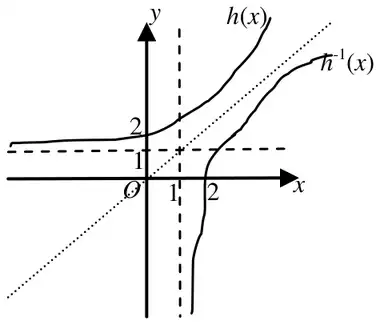 | G1 | \(h(x)\) with \(y=1\) as asymptote |
| G1 | \(h^{-1}(x)\) with \(x=1\) as asymptote | |
| G1 | (0, 2), (2,0) | |
| (iii) \(gh(x)=g(\mathrm{e}^x+1)\) | M1 | accept \((h(x))^2-1\) |
| \(gh(x)=(\mathrm{e}^x+1)^2-1\) | ||
| \(gh(x)=\mathrm{e}^{2x}+2\mathrm{e}^x\) or \(\mathrm{e}^x(\mathrm{e}^x+2)\) | A1 | |
| [8] | ||