
Maclaurin 2020 Q4
4. The diagram shows a triangle \(ABC\) and two lines \(AD\) and \(BE\), where \(D\) is the midpoint of \(BC\) and \(E\) lies on \(CA\). The lines \(AD\) and \(BE\) meet at \(Z\), the midpoint of \(AD\).
What is the ratio of the length \(CE\) to the length \(EA\)?
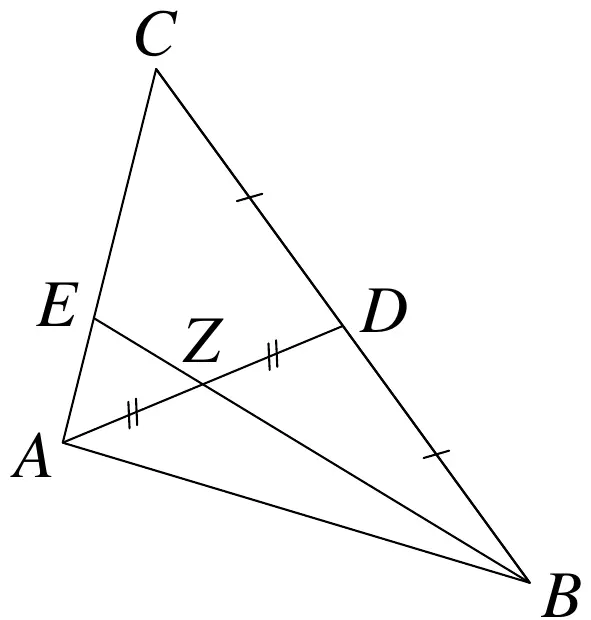
Maclaurin Olympiad 2020, Question 4. © UK Mathematics Trust. Original paper on ukmt.org.uk
Answer: 2 : 1
AUsing areas
Since \(CD = DB\), \([CDZ] = [BDZ]\) and, since \(DZ = ZA\), \([BDZ] = [BAZ]\).
Now, considering triangles on the side \(CA\), we have \(\dfrac{[CEZ]}{[AEZ]} = \dfrac{[CZB]}{[AZB]} = 2\), and it follows that \(CE : EA = 2 : 1\).
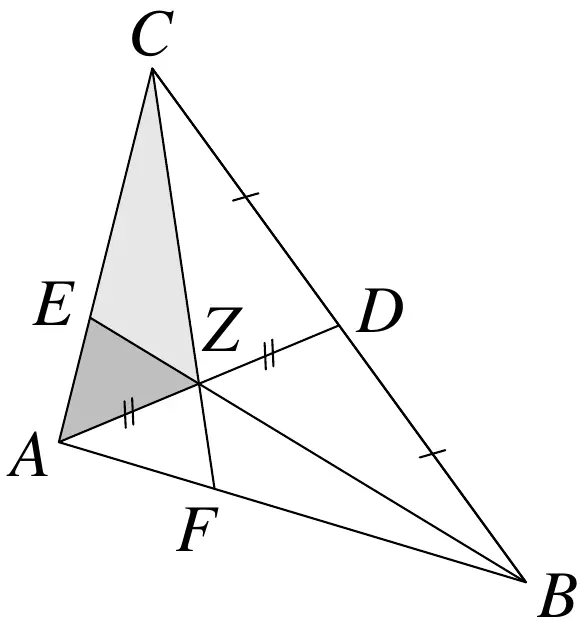
What is being used here is the useful ‘arrowhead’ shortcut which links the shaded areas directly to the unshaded ones. It is more likely that solvers will proceed via the step \(\dfrac{[CEZ]}{[AEZ]} = \dfrac{[CEB]}{[AEB]}\) and then use a bit of algebra. Alternatively, some might be aware that if \(\dfrac{a}{b} = \dfrac{c}{d}\), it follows that \(\dfrac{a}{b} = \dfrac{a - c}{b - d}\).
BUsing vectors
Let \(A\) be the origin and denote \(B\) and \(C\) by \(4\mathbf{b}\) and \(4\mathbf{c}\) respectively. Then \(D\) is \(2(\mathbf{b} + \mathbf{c})\) and \(Z\) is \(\mathbf{b} + \mathbf{c}\). Now \(E\) lies on both \(BZ\) and \(AC\), so there are real numbers \(\lambda\), \(\mu\) such that \(4\mu\mathbf{c} = \lambda(\mathbf{b} + \mathbf{c}) + 4(1 - \lambda)\mathbf{b}\). Hence \(\lambda = \tfrac{4}{3}\) and \(\mu = \tfrac{1}{3}\), so \(CE : AE = 2 : 1\).
CUsing construction
Let \(X\) be on \(BA\) such that \(BA = AX\). Then \(CA\) is a median of triangle \(BCX\).
The triangles \(BDA\) and \(BCX\) are similar, by ratios, so \(BE\), which is a median of \(BDA\), is also a median of \(BCX\).
Hence \(E\) is the centroid of \(BCX\) and so \(CE : EA = 2 : 1\)
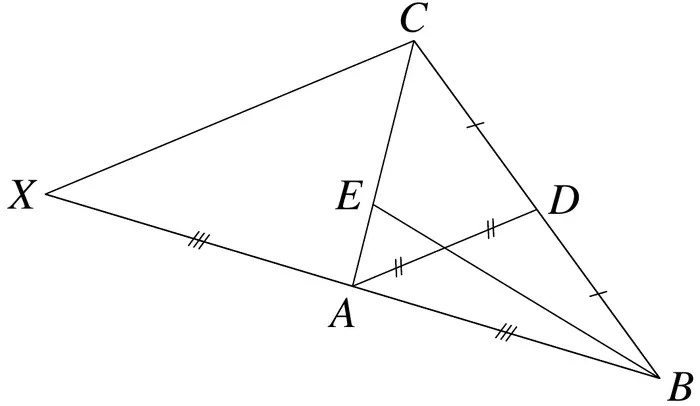
There are several other constructions which work. Other approaches use coordinate geometry, vectors and complex numbers. Ratio theorems such as Ceva and Menelaus are also useful.
Solution © UK Mathematics Trust, from the Maclaurin Olympiad 2020 solutions.