
Maclaurin 2016 Q3
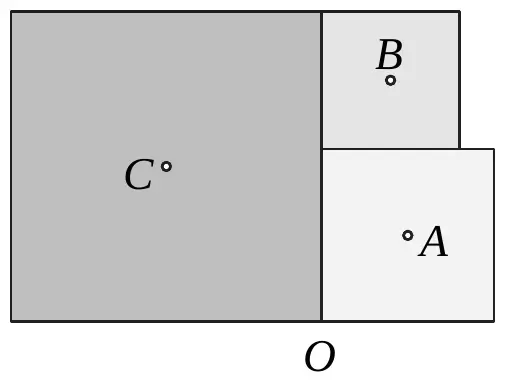
3. The diagram shows three squares with centres \(A\), \(B\) and \(C\). The point \(O\) is a vertex of two squares.
Prove that \(OB\) and \(AC\) are equal and perpendicular.
Maclaurin Olympiad 2016, Question 3. © UK Mathematics Trust. Original paper on ukmt.org.uk
Let the three squares with centres \(A\), \(B\) and \(C\) have sides of length \(2a\),\(2b\) and \(2c\) respectively. Then
Introduce coordinate axes as shown.
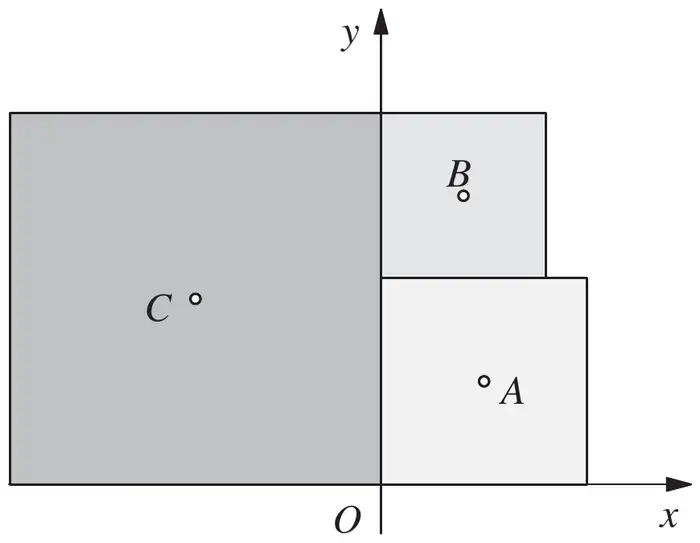
Then \(A = (a, a)\), \(B = (b, 2a + b)\) and \(C = (-c, c)\).
Now consider the right-angled triangles \(OBF\) and \(ACP\) shown in the next diagram, where \(PA\) is parallel to the \(x\)-axis.
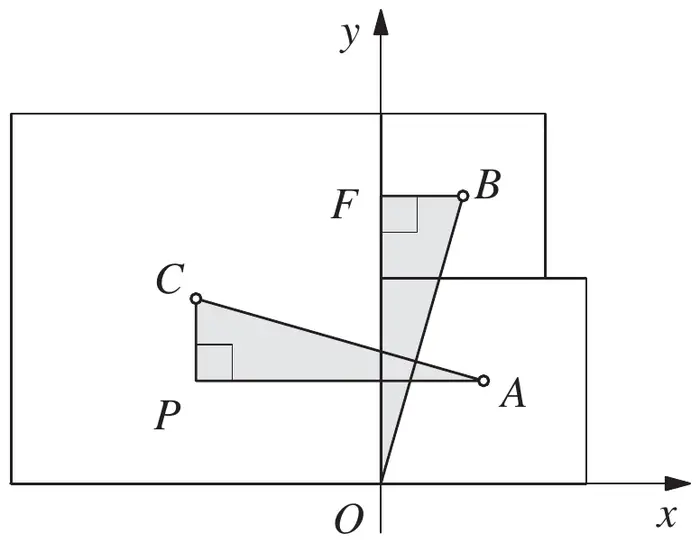
We have \(BF = b\) and \(OF = 2a + b\). Also \(CP = c - a\) and \(PA = c + a\). Using equation (∗), we get \(CP = b\) and \(PA = 2a + b\). Thus \(CP = BF\) and \(PA = OF\). Using either congruent triangles (SAS) or Pythagoras' Theorem, we therefore obtain \(CA = OB\).
Now the gradient of \(OB\) is \(\dfrac{FO}{BF}\) and the gradient of \(AC\) is \(-\dfrac{CP}{PA}\). It follows that the product of these gradients is \(-1\), and hence \(OB\) and \(AC\) are perpendicular.
Solution © UK Mathematics Trust, from the Maclaurin Olympiad 2016 solutions.