
Hamilton 2015 Q3
3. The diagram shows two circular arcs \(CP\) and \(CQ\) in a right-angled triangle \(ABC\), where \(\angle BCA = 90^\circ\).
The centres of the arcs are \(A\) and \(B\).
Prove that \(\tfrac{1}{2}PQ^2 = AP \times BQ\).
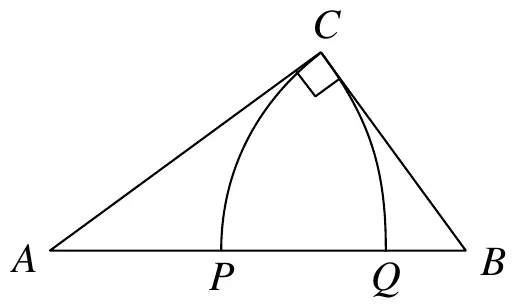
Hamilton Olympiad 2015, Question 3. © UK Mathematics Trust. Original paper on ukmt.org.uk
Let \(BC\), \(CA\) and \(AB\) have lengths \(a\), \(b\) and \(c\) respectively. Now triangle \(ABC\) is right-angled, so applying Pythagoras' Theorem, we get
Since \(A\) and \(B\) are the centres of the arcs, we have \(BP = a\) and \(AQ = b\), and hence \(AP = c - a\) and \(BQ = c - b\). Therefore
Furthermore,
Hence
So, from \(a^2 + b^2 = c^2\), we get
Thus \(\tfrac{1}{2}PQ^2 = AP \times BQ\), as required.
Solution © UK Mathematics Trust, from the Hamilton Olympiad 2015 solutions.