
June 2023 Paper 1 Q10
10
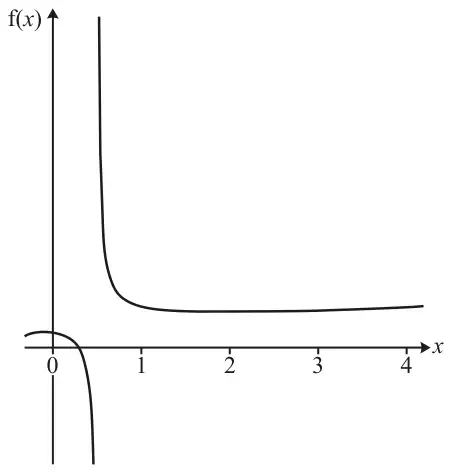
The diagram shows part of the curve \(\mathrm{f}(x) = \dfrac{\mathrm{e}^x}{4x^2 - 1} + 2\). The equation \(\mathrm{f}(x) = 0\) has a positive root \(\alpha\) close to \(x = 0.3\).
By considering \(\mathrm{F}'(0.3)\) explain why this iterative formula will not find \(\alpha\). [3]
| Scheme | Marks | AO |
|---|---|---|
| Both \(\mathrm{f}(0)\) and \(\mathrm{f}(1)\) are positive so no sign change will be seen | B1 | 2.3 |
| [1] |
Notes
B1: Identify both \(y\)-values being positive and state ‘no sign change’ or equiv
Could also evaluate \(\mathrm{f}(0)\) as 1 and \(\mathrm{f}(1)\) as 2.9 (or better), and refer to no sign change – these are both positive so no need to include \(\gt 0\)
Could also refer to the asymptote / discontinuity within this range (\(x = 0\) to \(x = 1\))
Also allow ‘graph is not continuous in this interval’
B0 for no reference to interval
Could say that the two points chosen are not on the same part of the curve
| Scheme | Marks | AO |
|---|---|---|
| \(\dfrac{\mathrm{e}^x}{4x^2 - 1} = -2\) \(\mathrm{e}^x = -8x^2 + 2\) \(8x^2 = 2 - \mathrm{e}^x\) | M1 | 1.1 |
| \(16x^2 = 4 - 2\mathrm{e}^x\) \(4x = \sqrt{4 - 2\mathrm{e}^x}\) \(x = \dfrac{1}{4}\sqrt{\left(4 - 2\mathrm{e}^x\right)}\) A.G. | A1 | 1.1 |
| [2] |
Notes
M1: Attempt rearrangement, as far as \(kx^2 = \ldots\)
Allow sign error(s) only
A1: Obtain given answer convincingly
If \(x = \sqrt{\dfrac{1}{4} - \dfrac{1}{8}\mathrm{e}^x}\) then an additional line of working needed before given answer (eg show common denominator of 16)
| Scheme | Marks | AO |
|---|---|---|
| \(x_2 = 0.285074813\ldots\) | B1 | 1.1 |
| 0.28943, 0.28817, 0.28853, 0.28843, 0.28846, 0.28845... | M1 | 1.1 |
| \(\alpha = 0.2885\) | A1 | 1.1 |
| [3] |
Notes
B1: Correct first iterate (at least 4sf)
State 0.2851 or better
M1: Correct iterative process (at least 3 more values)
Allow M1 for 3sf – expect 0.289, 0.288 and then 0.288 or 0.289 depending whether truncating or rounding
A1: Correct root, given to 4sf, following 2 iterates that agree to 4sf
ie at least 7 iterations needed, given to at least 4sf
A0 for eg \(x_8 = 0.2885\) (implies 8th iterate and not root)
Process self corrects so B0M1A1 possible; or B1M1A1 if error in term other than \(x_2\)
| Scheme | Marks | AO |
|---|---|---|
| \(\mathrm{F}'(x) = \dfrac{-16x}{2 - 8x^2}\) | M1 | 1.1a |
| \(\mathrm{F}'(0.3) = -3.75\) | M1 | 1.1 |
| For convergence \(|\mathrm{F}'(\alpha)| \lt 1\), but \(-3.75 \lt -1\), so iteration will not find root | A1 | 2.5 |
| [3] |
Notes
M1: Attempt differentiation using the chain rule
Obtain derivative of form \(\dfrac{kx}{2 - 8x^2}\)
Condone subscripts still present in derivative
M1: Attempt \(\mathrm{F}'(0.3)\) – not dependent on previous M1, but must follow some attempt at differentiation
M1 can be implied by correct \(-3.75\) (from correct derivative), but explicit substitution must be seen if \(\mathrm{F}'(x)\) is incorrect
Must come from differentiating \(\mathrm{F}(x)\) and not a different function
A1: Correct reasoning, following correct \(\mathrm{F}'(0.3)\)
Allow \(\mathrm{F}'(\alpha) \lt -1\), hence will not converge
Condone \(\mathrm{F}'(x)\) not \(\mathrm{F}'(\alpha)\)
No credit for just testing the given iterative formula