
June 2019 Paper 1 Q11
11
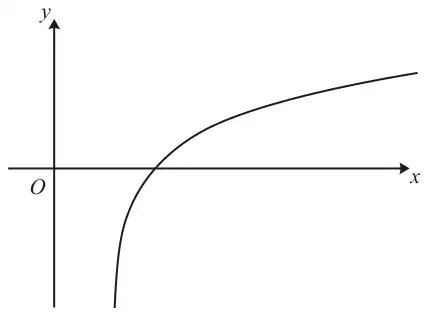
The diagram shows part of the curve \(y = \ln(x - 4)\).
| Scheme | Marks | AO |
|---|---|---|
| \(\displaystyle\int 1.\ln(x - 4)\,\mathrm{d}x\) so \(u = \ln(x - 4)\) and \(v' = 1\) | M1 | 1.1a |
| \(x\ln|x - 4| - \displaystyle\int \frac{x}{x - 4}\,\mathrm{d}x\) | A1 | 1.1 |
| \(\displaystyle\int \frac{x}{x - 4}\,\mathrm{d}x = \int 1 + \frac{4}{x - 4}\,\mathrm{d}x\) | M1 | 3.1a |
| \(= x + 4\ln|x - 4|\) | A1 | 1.1 |
| \(\displaystyle\int \ln(x - 4)\,\mathrm{d}x\) \(= x\ln|x - 4| - x - 4\ln|x - 4| + c\) \(= (x - 4)\ln|x - 4| - x + c\) A.G. | A1 | 2.4 |
| [5] |
Notes
M1: Attempt integration by parts, with correct parts.
\(u\) and \(v'\) correctly allocated and correct formula used
M0 if \(v = x - 4\) from \(v' = 1\)
A1: Correct expression.
Allow brackets not modulus
Allow \(x \times \dfrac{1}{x - 4}\), even if subsequently spoilt
M1: Attempt to deal with improper fraction.
Allow sign error ie \(1 - \dfrac{4}{x - 4}\)
Could use substitution of \(u = x - 4\) but must get as far as a proper fraction (ie \(1 \pm 4u^{-1}\))
Do not need to actually integrate for M1
A1: Correct integration of fraction.
Allow brackets not modulus
Using a substitution gives \(x - 4 + 4\ln|x - 4|\); must be in terms of \(x\) and not \(u\) for A1
A1: Show given answer with no errors seen.
Modulus required in final answer, as well as \(+ c\)
Can go from penultimate line in MS to given answer with no further detail needed
Answer from using substitution will need to justify changing \(c\) eg \(c + 4\) is a constant hence \(c'\) is also a constant
NB differentiating given answer is 0/5
Alternative
OR
B1 – use substitution of \(v = x - 4\), with \(\dfrac{\mathrm{d}v}{\mathrm{d}x} = 1\) seen, to obtain \(\displaystyle\int \ln v\,\mathrm{d}v\)
if B0 as it is not explicit then next 4 marks are still available
M1 – attempt integration by parts on \(\displaystyle\int \ln v\,\mathrm{d}v\), using correct parts and correct formula
A1 – obtain \(v\ln|v| - v\) (allow no modulus)
A1 – obtain \((x - 4)\ln|x - 4| - (x - 4)\)
A1 – obtain given answer, including modulus sign, and with justification for their \(c\) becoming \(c'\)
| Scheme | Marks | AO |
|---|---|---|
| State \(x = 4\) | B1 | 2.2a |
| [1] |
Notes
B1: Must be an equation
| Scheme | Marks | AO |
|---|---|---|
| \(\left|\displaystyle\int_5^7 \ln(x - 4)\,\mathrm{d}x\right| + \left|\displaystyle\int_{4.5}^5 \ln(x - 4)\,\mathrm{d}x\right|\) | M1 | 3.1a |
| \((3\ln 3 - 2) + (\frac{1}{2}\ln\frac{1}{2} + \frac{1}{2})\) | A1 | 1.1 |
| \(3\ln 3 - 2 - \frac{1}{2}\ln 2 + \frac{1}{2}\) | M1 | 3.1a |
| \(3\ln 3 - \frac{1}{2}\ln 2 - \frac{3}{2}\) | A1 | 1.1 |
| [4] |
Notes
M1: Attempt sum of absolute areas.
Or integral \(\displaystyle\int_5^7 \ln(x - 4)\,\mathrm{d}x - \int_{4.5}^5 \ln(x - 4)\,\mathrm{d}x\)
A1: Correct expression for area.
Any unsimplified equiv
M1: Attempt to rearrange to required form.
Use \(\ln\frac{1}{2} = -\ln 2\) and gather like terms
Could follow M0
Allow M1 (implied) for \(3\ln 3 + 0.5\ln 2 - 2.5\), even if \(-0.5\ln 0.5\) not seen first
A1: Obtain \(3\ln 3 - \frac{1}{2}\ln 2 - \frac{3}{2}\).
Or \(3\ln 3 - 0.5\ln 2 - 1.5\)