
June 2025 Paper 3 Q6
6 The diagram shows the curve with equation \(y = \mathrm{f}(x)\), where \(\mathrm{f}(x) = 13x - 34\ln(x) - 1.5\) for \(x > 0\).
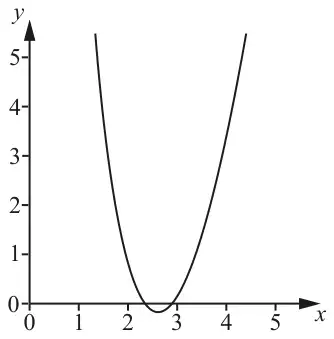
Explain why the student’s method may lead to the conclusion that \(\mathrm{f}(x) = 0\) has no roots. [1]
| Scheme | Marks | AO |
|---|---|---|
| Explanation, e.g. • The function is positive for all integers so there will be no change of sign • There are two roots between 2 and 3 but the student only checks integers | B1 | 2.4 |
| [1] |
Notes
B1: See appendix
Or f(2) and f(3) both positive so no change of sign
Or there are two roots between 2 and 3 which will be missed
Must mention integers if they don’t explicitly state 2 and 3
ignore attempts to evaluate f(2) and f(3)
Must have either ‘no sign change’ or ‘two roots’
Appendix: exemplar responses for Q6(a)
| Response | Mark |
|---|---|
| The following comments earn B1 | |
| The graph has two roots between 2 and 3 but since the \(y\) values and both 2 and 3 are positive, no change in sign will be detected so the student will not find the roots. | B1 |
| The change of sign would go unnoticed between 2 and 3 on the \(x\) axis | B1 |
| Both roots are between the positive integers 2 and 3 therefore a change of sign will not be observed. | B1 |
| \(x=2\), \(\mathrm{f}(x) = 0.933\) \(x = 3\), \(\mathrm{f}(x) = 0.147\) so there is no change of sign so no roots determined | B1 |
| The following comments earn B0 | |
| Student uses integer which when you use f(2) and f(3) both values are positive therefore it could not be used to locate a root | B0 as no explicit mention of change of sign |
| As he may skip over the exact moment \(\mathrm{f}(x)=0\) due to the interval change/resolution of the spreadsheet data. | B0 as change of sign not mentioned or that there are two roots between 2 and 3 |
| She uses integer values the roots are between the integers 2 and 3 the graph \(\mathrm{f}(x)\) is always positive at these values. | B0 as no explicit mention of change of sign or 2 roots |
| It has 2 roots. | B0 as no explicit mention of change of sign or 2 roots between integers 2 and 3 |
| Because there is a ln term in the equation. | B0 as no mention of change of sign or 2 roots |
| The student might miss an \(x\) value that correlates to \(\mathrm{f}(x)=0\) | B0 as no mention of change of sign or 2 roots between 2 and 3. |
| Scheme | Marks | AO |
|---|---|---|
| \(\dfrac{\mathrm{d}y}{\mathrm{d}x} = 13 - \dfrac{34}{x} = 0\) | M1 | 1.1a |
| \(x = \frac{34}{13}\) or \(2\frac{8}{13}\) | A1 | 1.1 |
| [2] |
Notes
M1: Differentiation and setting equal to zero.
Constant must differentiate to zero; sign errors condoned.
Allow for \(13 + \frac{k}{x} = 0\) where \(k\) is a non-zero constant
Condone poor/no notation
A1: Exact fraction or recurring decimal \(2.\dot{6}1538\dot{4}\) (if given as a decimal correct dot notation oe must be used)
Ignore \(y\) value if seen
isw decimals after correct answer seen