The questions in this section refer to the article on the Insert. You should read the article before attempting the questions.
The relevant parts of the article “Modelling a tube” are reproduced below; the line numbers are those printed on the Insert.
Lines 18–20 Taking the \(y\)-axis as the axis of symmetry of the tube and looking at the tube from the side, as shown in Fig. C2, means that the side width of the tube is \(2x\) at height \(y\).
Line 21 When \(y = 0\), \(x = r\) and when \(y = h\), \(x = 0\).
Lines 22–24 Assuming that the relationship between \(x\) and \(y\) is linear means that the side width decreases at a constant rate as \(y\) increases; this leads to \(ry + hx = hr\).
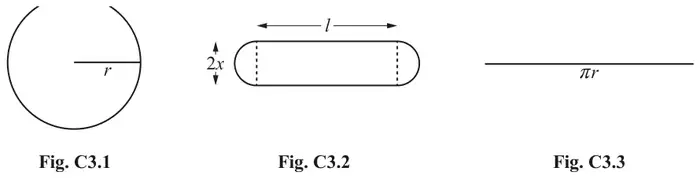
Lines 25–27 The cross-section at the bottom of the tube is a circle, as shown in Fig. C3.1; at the top of the tube, the cross-section is a line, as shown in Fig. C3.3.
Lines 28–29 The exact ‘oval’ shape of the cross-section at intermediate points is not easy to determine, so a simple approximation for the shape is used.
Lines 30–34 When the width of the tube is \(2x\), the cross-section will be modelled as a rectangle with semicircular ends, as shown in Fig. C3.2. The radius of the semicircular ends is \(x\). To ensure that the total perimeter of the cross-section is a constant, the length, \(l\), of the rectangular part of the cross-section is given by \(l = \pi(r - x)\). It can be shown that this ensures that the front width of the tube increases at a constant rate as \(y\) increases, as required by the modelling assumptions.
Line 35 Calculating the volume
Lines 36–37 Finding the area of the cross-section shown in Fig. C3.2 and using \(ry + hx = hr\) gives the cross-sectional area in terms of \(y\) as \(\dfrac{\pi r^2}{h^2}(h^2 - y^2)\).
(a)
(i) Show that the cross-sectional area in Fig. C3.2 is \(\pi x(2r - x)\). [2]
(ii) Hence show that the cross-sectional area is \(\dfrac{\pi r^2}{h^2}(h^2 - y^2)\), as given in line 37. [2]
(b) Verify that the formula \(\dfrac{\pi r^2}{h^2}(h^2 - y^2)\) for the cross-sectional area is also valid for
We'd like to use Google Analytics cookies to count visits and see which pages help most. They're optional, and the site works exactly the same either way. Privacy policy