
June 2018 Paper 3 Q14
14
The questions in this section refer to the article on the Insert. You should read the article before attempting the questions.
The relevant parts of the article “Arithmetic and Geometric Means” are reproduced below; the line numbers are those printed on the Insert.
Lines 17–23
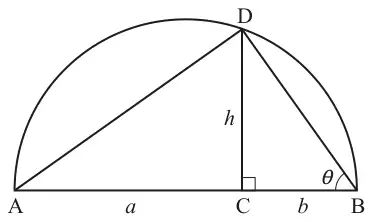
The line AB is first bisected, to locate its midpoint. A semicircle with AB as diameter is then drawn, and a line at C perpendicular to the diameter is constructed. Fig. C1.2 shows this semicircle, with the perpendicular line through C meeting the semicircle at D.
The radius of the semicircle is the arithmetic mean of \(a\) and \(b\), and the length of CD is the geometric mean of \(a\) and \(b\).
To prove that the length of CD is the geometric mean of \(a\) and \(b\), consider triangles ACD and BCD, as shown in Fig. C1.3.
Lines 23–24
Letting angle CBD \(= \theta\), it follows that angle CDA is also \(\theta\). Finding expressions for \(\tan\theta\) in each of triangles ACD and BCD leads to \(h = \sqrt{ab}\), where \(h\) is the length of CD.
| Scheme | Marks | AO |
|---|---|---|
| Angle BDC \(= 90 - \theta\) (angles of triangle) | M1 | 2.1 |
| Angle CDA \(= \theta\) (Angle ADB \(= 90^\circ\) as it is the angle in a semicircle) | E1 | 2.2a |
| [2] |
Notes
M1: Including reason
E1: Answer given so mark is for reason
Reasons can be given in either order
| Scheme | Marks | AO |
|---|---|---|
| Triangle ACD, \(\tan\theta = \dfrac{a}{h}\); Triangle BCD, \(\tan\theta = \dfrac{h}{b}\) | M1 | 1.1 |
| \(\dfrac{a}{h} = \dfrac{h}{b} \Rightarrow h^2 = ab \Rightarrow h = \sqrt{ab}\) | E1 | 2.1 |
| [2] |
Notes
M1: At least one correct expression for \(\tan\theta\)
Alternative method: triangle ACD is similar to triangle DBC
E1: Setting expressions equal and correct completion to given answer
AG
(corrected from the printed mark scheme: the printed scheme labels \(\tan\theta = \frac{h}{b}\) as triangle ACD and \(\tan\theta = \frac{a}{h}\) as triangle BCD; the angle \(\theta\) is at D in triangle ACD, giving \(\frac{a}{h}\), and at B in triangle BCD, giving \(\frac{h}{b}\))