
June 2018 Paper 1 Q14
14 The velocity of a car, \(v\,\mathrm{m\,s^{-1}}\) at time \(t\) seconds, is being modelled. Initially the car has velocity \(5\,\mathrm{m\,s^{-1}}\) and it accelerates to \(11.4\,\mathrm{m\,s^{-1}}\) in 4 seconds.
In model A, the acceleration is assumed to be uniform.
Model A is refined so that the velocity remains constant once the car reaches \(17.8\,\mathrm{m\,s^{-1}}\).
In model B, the velocity of the car is given by
\[v = \begin{cases} 5 + 0.6t^2 - 0.05t^3 & \text{for } 0 \leqslant t \leqslant 8, \\ 17.8 & \text{for } 8 < t \leqslant 20. \end{cases}\]
| Scheme | Marks | AO |
|---|---|---|
| \(u = 5,\ v = 11.4,\ t = 4\) \(a = \dfrac{v - u}{t} = \dfrac{11.4 - 5}{4} = 1.6\) | M1 A1 | 3.1b 1.1b |
| \(v = 5 + 1.6t\) | A1 | 3.3 |
| [3] |
Notes
M1: Using suvat equation(s) leading to value for \(a\)
A1: Any form
A1: FT their \(a\)
| Scheme | Marks | AO |
|---|---|---|
| The car would not be able to accelerate indefinitely – the velocity would become too large | E1 | 3.5b |
| [1] |
| Scheme | Marks | AO |
|---|---|---|
| When \(v = 17.8\) \(t = \dfrac{17.8 - 5}{1.6} = 8\) | B1 | 1.1a |
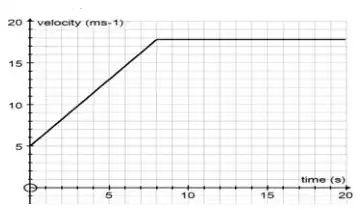 | G1 G1 | 1.1a 3.5c |
| [3] |
Notes
B1: Calculation or point on graph labelled at \(t = 8\)
G1: Two line segments with one horizontal
G1: Axes labelled.
(0, 5) and constant speed 17.8 clear on vertical scale
Mark intent for 17.8 – allow for a linear scale beyond 17.8
| Scheme | Marks | AO |
|---|---|---|
| Dividing area into sections | M1 | 3.1b |
| Area under trapezium \(= \dfrac{1}{2}\left(5 + 17.8\right) \times 8 = 91.2\) | A1 | 1.1a |
| Area rectangle \(12 \times 17.8 = 213.6\) Total displacement = 304.8 m | A1 | 1.1b |
| [3] |
Notes
M1: FT their graph if linear for M1 A0 for a triangle or trapezium area
A1: May be found as sum of areas. May be implied by correct total
A1: FT their distance found for first 8s
213.6 must be added to another distance
| Scheme | Marks | AO |
|---|---|---|
| When \(t = 4\quad v = 5 + 0.6 \times 4^2 - 0.05 \times 4^3 = 11.4\ \mathrm{m\,s^{-1}}\) Which matches the given value | B1 | 3.4 |
| [1] |
Notes
B1: Allow without comment
(corrected from the printed mark scheme: the printed scheme shows \(0.3 \times 4^2\); the model has \(0.6t^2\), and \(5 + 0.6 \times 16 - 0.05 \times 64 = 11.4\))
| Scheme | Marks | AO |
|---|---|---|
| \(\dfrac{\mathrm{d}v}{\mathrm{d}t} = 0.6 \times 2t - 0.05 \times 3t^2\ \left[= 1.2t - 0.15t^2\right]\) | M1 | 1.1a |
| When \(t = 8\quad v = 1.2 \times 8 - 0.15 \times 64 = 0\) Acceleration is zero at \(t = 8\) | A1 | 3.2a |
| which means that the car reaches its maximum speed without the sudden change in acceleration in model A. | E1 | 3.2a |
| [3] |
Notes
M1: Need not be simplified
A1: Must mention acceleration
E1: Must compare with model A
Final mark can be awarded independently for a statement about change in acceleration as long as supported by some numerical evidence
| Scheme | Marks | AO |
|---|---|---|
| EITHER \(\displaystyle\int_0^8 \left(5 + 0.6t^2 - 0.05t^3\right)\mathrm{d}t = \left[5t + 0.2t^3 - 0.0125t^4\right]_0^8\) | M1 | 2.1 |
| =91.2 m | A1 | 1.1b |
| which is same as model A for the first 8 s Distance is the same for the remainder of the time So this is the same as model A at \(t = 20\) | E1 | 2.1 |
| [3] |
Notes
A1: BC
E1: Must consider to \(t = 20\)
Allow for correct definite integral stated and calculator used.
Also allow M1A1 for \(5 \times 8 + 0.2 \times 8^3 - 0.0125 \times 8^4\) seen
(corrected from the printed mark scheme: the printed guidance shows \(5 \times 8 - 0.2 \times 8^3 - 0.0125 \times 8^4\); the integral gives \(+0.2 \times 8^3\), and \(40 + 102.4 - 51.2 = 91.2\))
OR
| Scheme | Marks |
|---|---|
| OR \(\displaystyle\int_0^8 \left(5 + 0.6t^2 - 0.05t^3\right)\mathrm{d}t = \left[5t + 0.2t^3 - 0.0125t^4\right]_0^8\) | M1 |
| =91.2 m | A1 |
| Distance at \(17.8\ \mathrm{m\,s^{-1}}\) 213.6 Total distance 304.8m [which is the same as model A] | A1 |
A1: BC
A1: Must consider to \(t = 20\)
Allow for correct definite integral stated and calculator used.