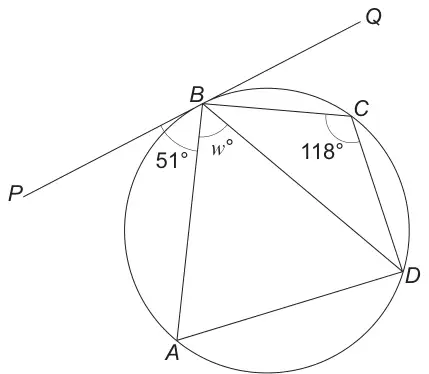
\(A\), \(B\), \(C\) and \(D\) are points on a circle. The line \(PQ\) is a tangent to the circle at \(B\).
\(P\hat{B}A = 51^\circ\), \(B\hat{C}D = 118^\circ\) and \(A\hat{B}D = w^\circ\).
Find the value of \(w\). You must show all your working.[3]
(b)
Diagram not drawn to scale
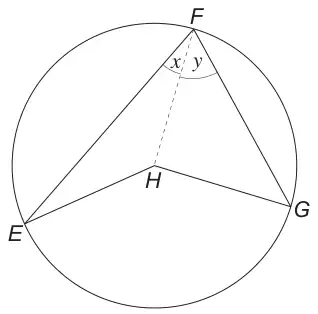
\(E\), \(F\) and \(G\) are points on a circle with centre \(H\). \(E\hat{F}H = x\) and \(G\hat{F}H = y\).
Complete the proof of the following statement:
The angle at the centre is twice the angle at the circumference. [4]
Proof:
\(E\hat{F}G = x + y\) \(F\hat{E}H = x\) (triangle \(FEH\) is isosceles) \(F\hat{H}E =\) ……………
Mark scheme (a)
Scheme
Marks
Comments
(Angle \(BAD =\)) \(62^\circ\)
B1
May be seen in diagram.
(Angle \(BDA =\)) \(51^\circ\) or (Angle \(QBD =\)) \(62^\circ\)
B1
(\(w =\)) 67
B1
Mark scheme (b)
Scheme
Marks
Comments
Angle \(FHE = 180 - 2x\) (Angles in a triangle)
B1
Allow angle \(G\) for angle \(FGH\) or angle \(E\) for angle \(HEF\).
Angle \(FGH = y\) (Triangle \(FGH\) is isosceles) AND Angle \(GHF = 180 - 2y\) (Angles in a triangle)
B1
Do not allow angle \(H\) for e.g. angle \(GHF\).
Angle \(EHG\) \(= 360 - (180 - 2x + 180 - 2y)\) \(= 2x + 2y\) or \(2(x + y)\) (Angles at a point)
(Therefore the angle at the centre is twice the angle at the circumference.)
B1
At least two correct reasons stated appropriately and all steps included in the proof.
E1
(7)
Alternative method for B marks
Scheme
Marks
Comments
(ignoring angle \(FHE =\)… and extending the line \(FH\) and using a naming convention to identify the exterior angle in the proof e.g. \(I\) for the end of the extension or marking the exterior angle as e.g. \(a\))
We'd like to use Google Analytics cookies to count visits and see which pages help most. They're optional, and the site works exactly the same either way. Privacy policy