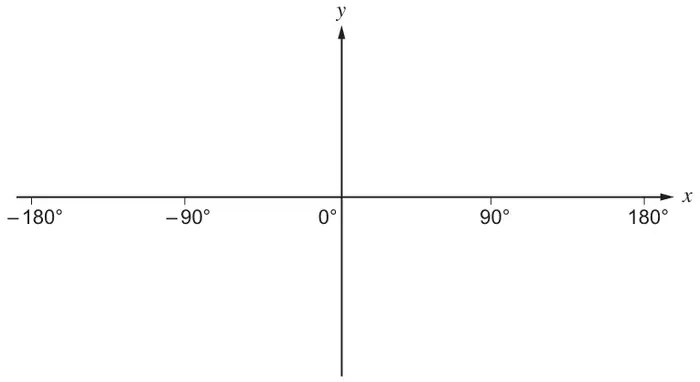
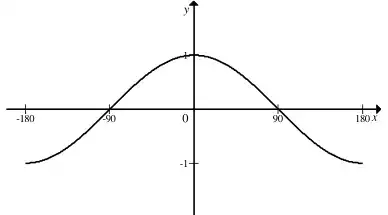
(i) On the axes below, sketch the graph of \(y = \cos x\) for \(-180^\circ \leqslant x \leqslant 180^\circ\). [2]
(ii) Solve \(\cos x = \dfrac{\sqrt{3}}{2}\) for \(-180^\circ \leqslant x \leqslant 180^\circ\). [2]
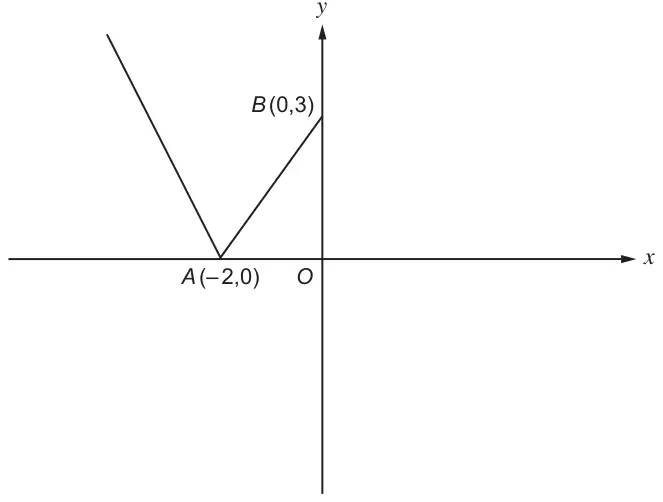
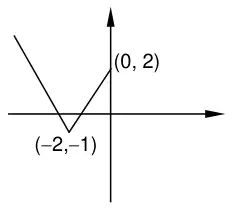
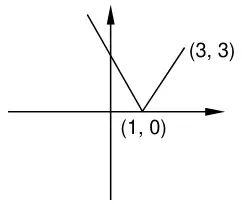
(b) The diagram shows a sketch of the graph of \(y = f(x)\). The point \(A\) has coordinates \((-2, 0)\) and the point \(B\) has coordinates \((0, 3)\).
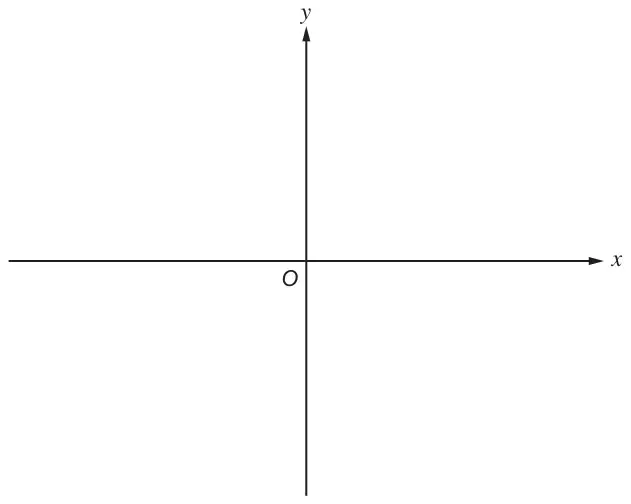
(i) Sketch the graph of \(y = f(x) - 1\) on the axes below. You must indicate the coordinates of the new positions of the points \(A\) and \(B\). [2]
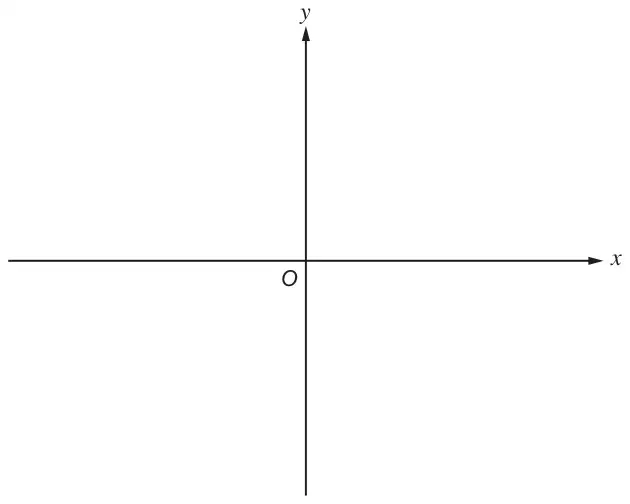
(ii) Sketch the graph of \(y = f(x - 3)\) on the axes below. You must indicate the coordinates of the new positions of the points \(A\) and \(B\). [2]
Mark scheme (a)
Scheme
Marks
Comments
(a)(i) Correct cosine graph over full domain with minima and maximum at −1 and 1 respectively
B2
B1 for correct shape over full domain but 1 and −1 not marked
OR for correct roots, minima and maximum but incorrect shape e.g. ruled sections
OR for the correct curve from at least 0° to 180° with 1 and −1 marked
(a)(ii) 30° , −30°
B2
And no extras in range B1 for either, ignoring extras; if no marks, award SC1 for stating \(\cos30 = \dfrac{\sqrt{3}}{2}\)
Mark scheme (b)
Scheme
Marks
Comments
(b)(i) Translation through \(\begin{pmatrix}0\\k\end{pmatrix}\), where \(k \lt 0\)
B1
Allow good freehand
Correct coordinates seen or scale marked
B1
(b)(ii) Translation through \(\begin{pmatrix}k\\0\end{pmatrix}\), where \(k \gt 0\)
We'd like to use Google Analytics cookies to count visits and see which pages help most. They're optional, and the site works exactly the same either way. Privacy policy