
S4 June 2011 Q4
4. A proportion \(p\) of letters sent by a company are incorrectly addressed and if \(p\) is thought to be greater than 0.05 then action is taken.
Using \(\mathrm{H}_0 : p = 0.05\) and \(\mathrm{H}_1 : p \gt 0.05\), a manager from the company takes a random sample of 40 letters and rejects \(\mathrm{H}_0\) if the number of incorrectly addressed letters is more than 3.
Table 1 below gives some values, to 2 decimal places, of the power function of this test.
| \(p\) | 0.075 | 0.100 | 0.125 | 0.150 | 0.175 | 0.200 | 0.225 |
|---|---|---|---|---|---|---|---|
| Power | 0.35 | \(s\) | 0.75 | 0.87 | 0.94 | 0.97 | 0.99 |
Table 1
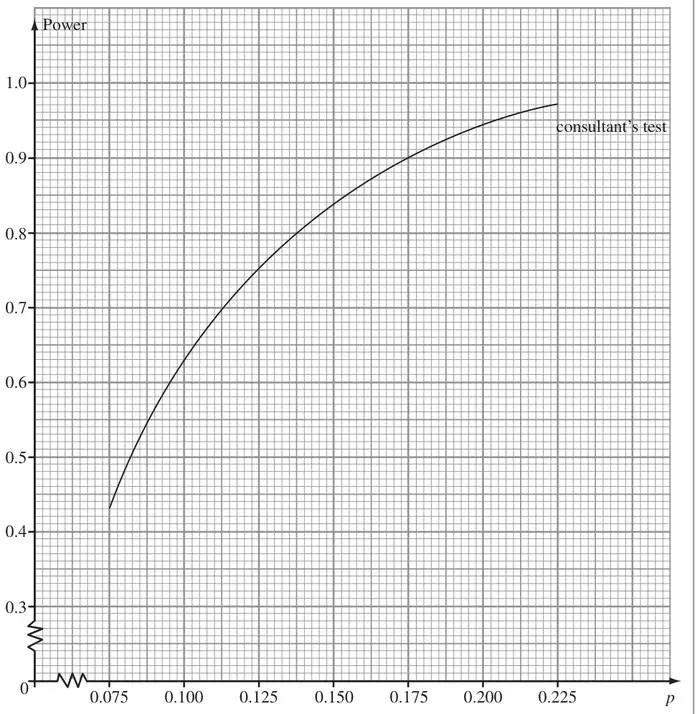
A visiting consultant uses an alternative system to test the same hypotheses. A sample of 15 letters is taken. If these are all correctly addressed then \(\mathrm{H}_0\) is accepted. If 2 or more are found to have been incorrectly addressed then \(\mathrm{H}_0\) is rejected. If only one is found to be incorrectly addressed then a further random sample of 15 is taken and \(\mathrm{H}_0\) is rejected if 2 or more are found to have been incorrectly addressed in this second sample, otherwise \(\mathrm{H}_0\) is accepted.
Figure 1 shows the graph of the power function of the test used by the consultant.
| Scheme | Marks |
|---|---|
| [\(X\) = no. of incorrectly addressed letters. \(X \sim \mathrm{B}(40, 0.05)\)] \(\mathrm{P}(X \gt 3) = 1 - \mathrm{P}(X \leqslant 3),\ = 1 - 0.8619 = 0.1381\) awrt 0.138 | M1, A1 |
| (2) |
Notes
M1 for \(1 - \mathrm{P}(X \leqslant 3)\) and \(X \sim \mathrm{B}(40, 0.05)\)
| Scheme | Marks |
|---|---|
| \(\mathrm{P}(\text{Type II Error}) = \mathrm{P}(X \leqslant 3 \mid p = 0.10)\) | M1 |
| \(= 0.4231\) awrt 0.423 | A1 |
| (2) |
Notes
M1 for a correct interpretation of P(Type II error)
| Scheme | Marks |
|---|---|
| Power = 1 - P(Type II error) so \(s = \underline{\mathbf{0.58}}\) (0.5769) | B1 |
| (1) |
Notes
B1 must be 2dp
| Scheme | Marks |
|---|---|
| \(Y\) = no. of incorrectly addressed letters in a sample of 15. \(Y \sim \mathrm{B}(15, 0.05)\) Size \(= \mathrm{P}(Y \geqslant 2) + \mathrm{P}(Y = 1) \times \mathrm{P}(Y \geqslant 2)\) | M1 |
| \(= [1 - 0.8290] \times [1 + 0.8290 - 0.4633]\) | A1 |
| \(= 0.23353\ldots\) awrt 0.23 | A1 |
| (3) |
Notes
M1 for a correct strategy
1st A1 for a correct numerical expression
| Scheme | Marks |
|---|---|
| (use overlay) | B1B1 |
| (2) |
Notes
1st B1 for correct points (accept ± one 2mm square)
2nd B1 for curve
| Scheme | Marks |
|---|---|
| 2nd/ consultants test is quicker (since it uses fewer letters) 2nd / consult test is more powerful for \(p \lt 0.125\) (and values greater than this should be unlikely) | B1 B1 |
| (2) | |
| (12 marks) |
Notes
1st B1 for selecting 2nd test
2nd B1 for a suitable supporting reason
eg more powerful for small values of \(p\)/\(p\) around 0.05