
M3 June 2016 Q4
4.
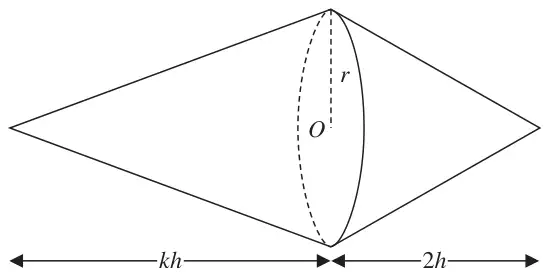
A uniform solid \(S\) consists of two right circular cones of base radius \(r\). The smaller cone has height \(2h\) and the centre of the plane face of this cone is \(O\). The larger cone has height \(kh\) where \(k > 2\). The two cones are joined so that their plane faces coincide, as shown in Figure 2.
The point \(A\) lies on the circumference of the base of one of the cones. The solid is suspended by a string attached at \(A\) and hangs freely in equilibrium.
Given that \(r = 3h\) and \(k = 6\)
| Scheme | Marks |
|---|---|
| Mass ratio \(\dfrac{2}{3}\pi r^2h \qquad \dfrac{1}{3}\pi r^2kh \qquad \dfrac{2}{3}\pi r^2h + \dfrac{1}{3}\pi r^2kh\) (or \(2 : k : (2 + k)\)) | B1 |
| Dist from \(O\) \(-\dfrac{1}{2}h \qquad \dfrac{1}{4}kh \qquad \bar{x}\) | B1 |
| \(2\left(-\dfrac{1}{2}h\right) + k \times \dfrac{k}{4}h = (2 + k)\bar{x}\) | M1A1ft |
| \(\bar{x} = \dfrac{\left(k^2 - 4\right)h}{4(2 + k)} = \dfrac{h(k - 2)(k + 2)}{4(2 + k)} = \dfrac{h}{4}(k - 2)\) * | A1cso |
| (5) |
Notes
B1 Correct ratio of volumes or masses - any form
B1 Correct distances from \(O\) or a vertex. One distance may be negative or all may be positive.
M1 Forming a moments equation. May be about \(O\) or either vertex.
A1ft Correct equation. All signs must be correct for their choice of point. Follow through the B marks.
A1cso Correct completion to the distance from \(O\). (Factorisation must be shown.)
NB: First four marks available for \(2\left(\dfrac{1}{2}h\right) - k \times \dfrac{k}{4}h = (2 + k)\bar{x}\) but \(k > 2\) must be stated as a reason for changing \(\dfrac{h}{4}(2 - k)\) to the given answer.
| Scheme | Marks |
|---|---|
| \(\tan\theta = \dfrac{\bar{x}}{r}\) | M1 |
| \(\tan\theta = \dfrac{32h}{4 \times 8 \times 3h}\) | A1 |
| \(\theta = 18.43\ldots\) or 0.321...rad Accept 18\(^\circ\) or 0.32 rad or better | A1 |
| (3) | |
| (8 marks) |
Notes
M1 Form an expression for \(\tan\theta\) using the given \(\bar{x}\) No need to substitute for \(r\) or \(k\) but \(\bar{x} = h \Rightarrow\) correct \(\bar{x}\) used. May be either way up
A1 Substitute for \(r\) and \(k\) to obtain a correct numerical (or equivalent to numerical) value for \(\tan\theta\)
A1 Correct angle, may be degrees or radians.