
M2 June 2016 Q4
4.
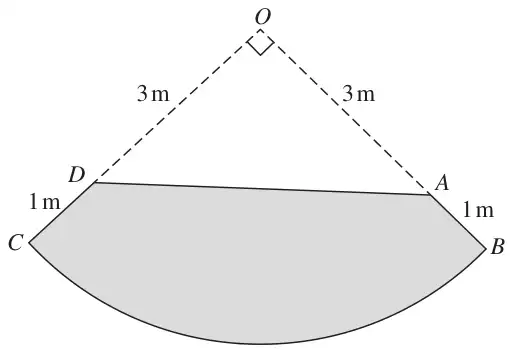
The uniform lamina \(OBC\) is one quarter of a circular disc with centre \(O\) and radius 4 m. The points \(A\) and \(D\), on \(OB\) and \(OC\) respectively, are 3 m from \(O\). The uniform lamina \(ABCD\), shown shaded in Figure 1, is formed by removing the triangle \(OAD\) from \(OBC\).
Given that the centre of mass of one quarter of a uniform circular disc of radius \(r\) is at a distance \(\dfrac{4\sqrt{2}}{3\pi}r\) from the centre of the disc,
The lamina is freely suspended from \(D\) and hangs in equilibrium.
| Scheme | Marks | |||||||||
|---|---|---|---|---|---|---|---|---|---|---|
| B1 B1 | |||||||||
| \(4\pi \times \dfrac{16\sqrt{2}}{3\pi} - 4.5\sqrt{2}\left(= \dfrac{101\sqrt{2}}{6}\right) = (4\pi - 4.5)d\) | M1 A1 | |||||||||
| \(d = \dfrac{101\sqrt{2}}{6(4\pi - 4.5)} = 2.951.....\) | ||||||||||
| Distance from \(DA\ = 2.951... - \dfrac{3\sqrt{2}}{2}\) \(= 0.830\ (0.83)\) m | A1 | |||||||||
| (5) |
Notes
B1 Mass ratios. B1 Distances. Distances from \(AD\) are \(-\dfrac{1}{3} \times \dfrac{3\sqrt{2}}{2}\) and \(\dfrac{16\sqrt{2}}{3\pi} - \dfrac{3\sqrt{2}}{2}\ (= 0.280)\)
M1 Moments about an axis through \(O\) and parallel to \(DA\). Terms must be dimensionally correct. Shapes combined correctly.
A1 Correct unsimplified equation
(distance from \(O\))
A1 Accept \(\dfrac{101\sqrt{2}}{6(4\pi - 4.5)} - \dfrac{3\sqrt{2}}{2}\)
4a alt
| B1 B1 | |||||||||
| \(4\pi \times \dfrac{16}{3\pi} - 4.5 \times 1 = (4\pi - 4.5)\bar{x}\) | M1 | |||||||||
| \(\left(\bar{x} = \bar{y} = \dfrac{101}{6(4\pi - 4.5)}\right)\) | A1 | |||||||||
| \(d = \dfrac{101\sqrt{2}}{6(4\pi - 4.5)}\) | ||||||||||
| Distance from \(DA\ = 2.951... - \dfrac{3\sqrt{2}}{2}\) \(= 0.830\ (0.83)\) m | A1 |
B1 Mass ratios. B1 Distances
M1 Moments about an axis through \(O\). Terms must be dimensionally correct. Condone sign error(s)
A1 Correct unsimplified equation
Distance from \(O\)
(Corrected from the printed mark scheme: the alternative moments equation is printed with “4.51” in place of \(4.5 \times 1\).)
| Scheme | Marks |
|---|---|
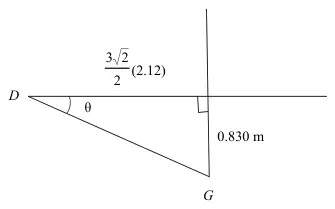
| \(\tan\theta = \dfrac{\text{their } 0.830}{2.12}\) or \(\tan\phi = \dfrac{2.12}{\text{their } 0.830}\) | M1 |
| 21.4\(^\circ\) or 68.6\(^\circ\) | A1 |
| Angle between DC and downward vertical \(= 135^\circ\) - their \(\theta\) | M1 |
| \(= 114^\circ\) | A1 |
| (4) | |
| (9 marks) |
Notes
M1 Use of tan to find a relevant angle:
M1 Correct method for the required angle
A1 The Q asks for the angle to the nearest degree.
4balt
| \(GD^2 = OD^2 + OG^2 - 2OD.OC\cos 45\) \((GD = 2.28)\ \ \ \ \ \dfrac{\sin 45}{DG} = \dfrac{\sin\theta}{OG}\) | M1 |
| \(\Rightarrow \theta = 66.4^\circ\) | A1 M1 |
| Required angle \(= 180 - 66.4 = 114^\circ\) | A1 |
M1 Complete method to find angle \(ODG\)
M1 Correct method for the required angle
A1 The Q asks for the angle to the nearest degree.