
M2 June 2015 Q4
4. A ladder \(AB\), of weight \(W\) and length \(2l\), has one end \(A\) resting on rough horizontal ground. The other end \(B\) rests against a rough vertical wall. The coefficient of friction between the ladder and the wall is \(\dfrac{1}{3}\). The coefficient of friction between the ladder and the ground is \(\mu\). Friction is limiting at both \(A\) and \(B\). The ladder is at an angle \(\theta\) to the ground, where \(\tan\theta = \dfrac{5}{3}\). The ladder is modelled as a uniform rod which lies in a vertical plane perpendicular to the wall.
Find the value of \(\mu\). (9)
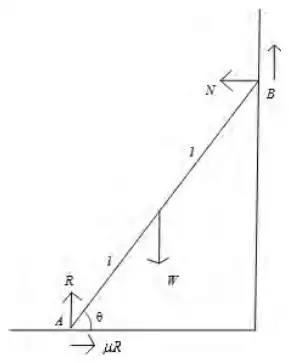
| Scheme | Marks |
|---|---|
| Resolve horizontally or vertically: | M1 |
| \(\mu R = N\) or \(W = R + \dfrac{1}{3}N\) | A1 |
| Take moments about \(A\) or \(B\). | M1 |
| \(M(A){:}\ 2lN\sin\theta + 2l\dfrac{N}{3}\cos\theta = Wl\cos\theta\) \(M(B){:}\ 2l\cos\theta R = Wl\cos\theta + \mu R2l\sin\theta\) | A2 |
| \(\dfrac{10}{3}N + \dfrac{2}{3}N = W\ \ \) or \(\ 2R = W + 2\mu R \times \dfrac{5}{3}\) | M1 |
| \(\Rightarrow 4N = W \Rightarrow 4N - R = \dfrac{1}{3}N\) | DM1 |
| \(\dfrac{11}{3}\mu R = R\) | DM1 |
| \(\mu = \dfrac{3}{11}\ (\approx 0.273)\) | A1 |
| (9) |
Notes
M1 Allow without friction \(= \mu R\)
A1 With coefficient(s) of friction. Condone \(Wg\)
M1 All terms required but condone sign errors and sin/cos confusion. Terms must be resolved.
A2 -1 each error. Could be in terms of \(F\)s. -1 if see \(Wg\) in place of \(W\). Any Friction force used should be acting in the right direction. Mark the equation, not what they have called it.
M1 Use \(\tan\theta = \dfrac{5}{3}\) (substitute values for the trig ratios)
DM1 Equation in \(N\) and \(R\) (Eliminate one unknown) Dependent on the moments equation
DM1 Solve for \(\mu\). Dependent on the moments equation
A1 0.27 or better
NB: If \(\mu\) and \(\dfrac{1}{3}\) are used the wrong way round the candidate loses the first A1 and the final A1.
Alt 1
| Resolve horizontally or vertically: | M1 |
| \(\mu R = N\) or \(W = R + \dfrac{1}{3}N\) | A1 M1 |
| \(M(A){:}\ 2lN\sin\theta + 2l\dfrac{N}{3}\cos\theta = Wl\cos\theta\) \(M(B){:}\ 2l\cos\theta R = Wl\cos\theta + \mu R2l\sin\theta\) | A2 |
| \(2lN\sin\theta + 2l\dfrac{N}{3}\cos\theta = 2l\cos\theta R - \mu R2l\sin\theta\) | DM1 |
| Use of \(\tan\theta\): \(\ 2\mu \times \dfrac{5}{3} + \dfrac{2}{3}\mu = 2 - 2\mu \times \dfrac{5}{3}\) | M1 |
| Solve for \(\mu\): \(\ \left(\dfrac{20}{3} + \dfrac{2}{3}\right)\mu = 2,\) | DM1 |
| \(\mu = \dfrac{3}{11}\ (\approx 0.273)\) | A1 |
M1 Allow without friction \(= \mu R\)
A1 With coefficient(s) of friction
M1 Take moments about \(A\) or \(B\). All terms required but condone sign errors and sin/cos confusion. Terms must be resolved.
A2 -1 each error, Could be in terms of \(F\)s. -1 if \(Wg\) used. Mark the equation, not what they have called it. Any Friction force used should be acting in the right direction. For this method they need two moments equations – allows the marks for their best equation.
DM1 Use two moments equations to eliminate \(W\). Dependent on the moments equation
M1 Substitute for the trig ratios
DM1 Dependent on the moments equation
A1 0.27 or better
Alt 2
| Resolving horizontally or vertically: | M1 |
| \(\mu R = N\) or \(W = R + \dfrac{1}{3}N\) | A1 |
| \(l\cos\theta \times R = l\cos\theta \times \dfrac{1}{3}N + l\sin\theta \times N + l\sin\theta \times \mu R\) | M1 A2 |
| \(l\cos\theta \times R = l\cos\theta \times \dfrac{1}{3}\mu R + l\sin\theta \times \mu R + l\sin\theta \times \mu R\) | DM1 |
| \(\cos\theta\left(1 - \dfrac{1}{3}\mu\right) = 2\mu\sin\theta \Rightarrow \ \tan\theta = \dfrac{1 - \frac{1}{3}\mu}{2\mu} = \dfrac{5}{3}\) | M1 |
| Solve for \(\mu\): \(\ 10\mu = 3 - \mu,\) | DM1 |
| \(\mu = \dfrac{3}{11}\ (\approx 0.273)\) | A1 |
M1 Allow without friction \(= \mu R\)
A1 With coefficient(s) of friction (condone \(Wg\))
M1 Moments about the centre of the rod. All terms required. Terms must be resolved. Condone sign errors and sin/cos confusion. Allow without friction \(= \dfrac{1}{3}N\). Any Friction force used should be acting in the right direction.
A2 -1 each error. Could be in terms of \(F\)s. -1 if \(Wg\) used.
DM1 Obtain an equation in \(\mu\) and \(\theta\) \(\left(\cos\theta = \cos\theta \times \dfrac{1}{3}\mu + \sin\theta \times \mu + \sin\theta \times \mu\right)\) Dependent on the moments equation
M1 Use of \(\tan\theta\) (substitute values for the trig ratios)
DM1 Dependent on the moments equation
A1 0.27 or better