
M2 June 2014 Q7
7.
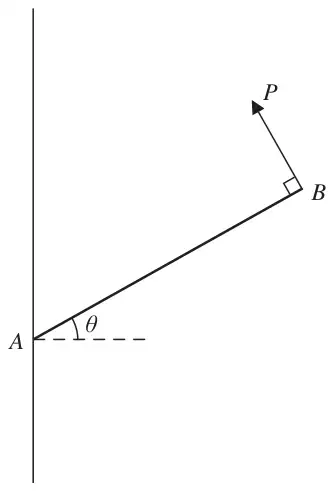
A uniform rod \(AB\) of weight \(W\) has its end \(A\) freely hinged to a point on a fixed vertical wall. The rod is held in equilibrium, at angle \(\theta\) to the horizontal, by a force of magnitude \(P\). The force acts perpendicular to the rod at \(B\) and in the same vertical plane as the rod, as shown in Figure 3. The rod is in a vertical plane perpendicular to the wall. The magnitude of the vertical component of the force exerted on the rod by the wall at \(A\) is \(Y\).
Given that \(\theta = 45^\circ\)
| Scheme | Marks |
|---|---|
| Resolving vertically: \(Y + P\cos\theta = W\) | M1 A1 |
| Moments about \(A\): \(Wl\cos\theta = 2lP\) | M1 A1 |
| \(P = \dfrac{W\cos\theta}{2} \Rightarrow Y = W - \dfrac{W\cos^2\theta}{2} = \dfrac{W}{2}\left(2 - \cos^2\theta\right)\ \ **\) | DM1 A1 |
| (6) |
Notes
M1 Needs all 3 terms. Condone sign errors and sin/cos confusion. Condone \(Wg\)
M1 Terms need to be of the correct structure, but condone \(l\) implied if not seen.
DM1 Substitute for \(P\) to obtain simplified \(Y\) Requires both preceding M marks
A1 Obtain given result correctly.
NB \(W + Y = P\cos\theta\) with correct conclusion is possible
They need to find two independent equations that do not include X. If they have equations involving X they need to attempt to eliminate X before they score any marks
| Scheme | Marks |
|---|---|
| \(\theta = 45^\circ \Rightarrow Y = \dfrac{3W}{4}\) | B1 |
| \(X = P\sin 45\) | M1 |
| \(= \dfrac{W\cos 45}{2}.\sin 45\ \left(= \dfrac{W}{4}\right)\) | DM1 A1 |
| Resultant at \(A = \dfrac{W}{4}\sqrt{3^2 + 1^2} = \dfrac{W\sqrt{10}}{4}\ \ \ \ \ (0.79W)\) | DM1 A1 |
| (6) | |
| (12 marks) |
Notes
M1 Resolving horizontally. Accept in terms of \(\theta\).
DM1 Express \(X\) in terms of \(W\). Accept in terms of \(\theta\). Requires preceding M mark.
A1 Correct unsimplified but substituted.
DM1 Use of Pythagoras with \(X\), \(Y\) in terms of \(W\) only. Dependent on the first M1
A1 Or equivalent (\(0.79W\) or better)
Alternative moments equations: about the centre \(Pl + X\sin\theta l = y\cos\theta l\)
About the point where the lines of action of P and X intersect \(Y \times \dfrac{2l}{\cos\theta} = W\left(\dfrac{2l}{\cos\theta} - l\cos\theta\right)\)