
M2 June 2007 Q5
5.
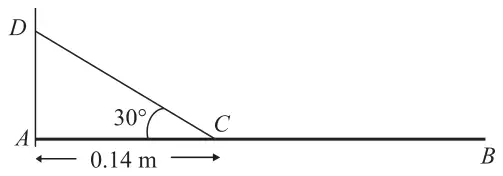
A uniform beam \(AB\) of mass 2 kg is freely hinged at one end \(A\) to a vertical wall. The beam is held in equilibrium in a horizontal position by a rope which is attached to a point \(C\) on the beam, where \(AC = 0.14\) m. The rope is attached to the point \(D\) on the wall vertically above \(A\), where \(\angle ACD = 30^\circ\), as shown in Figure 3. The beam is modelled as a uniform rod and the rope as a light inextensible string. The tension in the rope is 63 N.
Find
| Scheme | Marks |
|---|---|
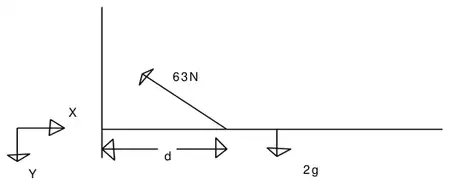
| M\((A)\) \(63\sin 30 \cdot 0.14 = 2g \cdot d\) | M1 A1 A1 |
| Solve: \(d = 0.225\) m | |
| Hence \(AB = 45\) cm | A1 |
| (4) |
Notes
M1 Take moments about A. 2 recognisable force \(\times\) distance terms involving 63 and \(2(g)\).
A1 63 N term correct
A1 \(2g\) term correct.
A1 \(AB = 0.45\)(m) or 45(cm). No more than 2sf due to use of \(g\).
(Corrected from the printed mark scheme: the moments equation is printed as \(63\sin 30 \cdot 14 = 2g \cdot d\).)
| Scheme | Marks |
|---|---|
| R\((\rightarrow)\) \(X = 63\cos 30\ \ (\approx 54.56)\) | B1 |
| R\((\uparrow)\) \(Y = 63\sin 30 - 2g\ \ (\approx 11.9)\) | M1 A1 |
| \(R = \sqrt{X^2 + Y^2} \approx 55.8\), 55.9 or 56 N | M1 A1 |
| (5) | |
| (9 marks) |
Notes
B1 Horizontal component (Correct expression – no need to evaluate)
M1 Resolve vertically – 3 terms needed. Condone sign errors. Could have cos for sin.
Alternatively, take moments about B: \(0.225 \times 2g = 0.31 \times 63\sin 30 + 0.45Y\)
or C: \(0.14Y = 0.085 \times 2g\)
A1 Correct expression (not necessarily evaluated) – direction of Y does not matter.
M1 Correct use of Pythagoras
A1 55.8(N), 55.9(N) or 56 (N)
OR For X and Y expressed as \(F\cos\theta\) and \(F\sin\theta\).
M1 Square and add the two equations, or find a value for \(\tan\theta\), and substitute for \(\sin\theta\) or \(\cos\theta\)
A1 As above.
N.B. Part (b) can be done before part (a). In this case, with the extra information about the resultant force at A, part (a) can be solved by taking moments about any one of several points. M1 in (a) is for a complete method – they must be able to substitute values for all their forces and distances apart from the value they are trying to find.