
M2 January 2011 Q7
7.
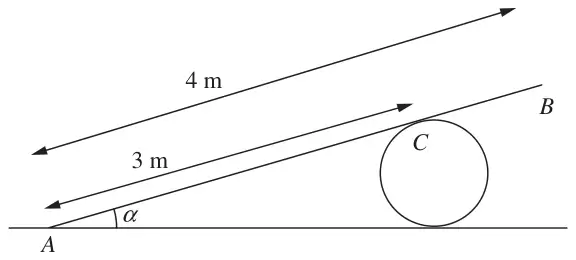
A uniform plank \(AB\), of weight 100 N and length 4 m, rests in equilibrium with the end \(A\) on rough horizontal ground. The plank rests on a smooth cylindrical drum. The drum is fixed to the ground and cannot move. The point of contact between the plank and the drum is \(C\), where \(AC = 3\) m, as shown in Figure 4. The plank is resting in a vertical plane which is perpendicular to the axis of the drum, at an angle \(\alpha\) to the horizontal, where \(\sin\alpha = \dfrac{1}{3}\). The coefficient of friction between the plank and the ground is \(\mu\). Modelling the plank as a rod, find the least possible value of \(\mu\). (10)
| Scheme | Marks |
|---|---|
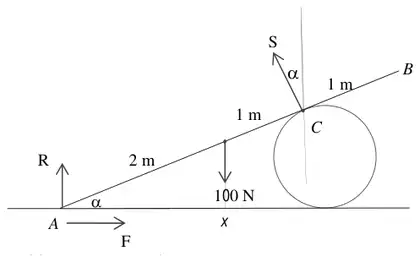
| Taking moments about A: | |
| \(3S = 100 \times 2 \times \cos\alpha\) | M1 A1 |
| Resolving vertically: | |
| \(R + S\cos\alpha = 100\) | M1 A1 |
| Resolving horizontally: | |
| \(S\sin\alpha = F\) | M1 A1 |
| (Most alternative methods need 3 independent equations, each one worth M1A1. Can be done in 2 e.g. if they resolve horizontally and take moments about \(X\) then \(\ R \times 2 \times \cos\alpha = S \times (3 - 2 \times \cos^2\alpha)\ \) scores M2A2) | |
| Substitute trig values to obtain correct values for F and R (exact or decimal equivalent). | DM1 |
| \(\left(S = \dfrac{200\sqrt{8}}{9}\right),\ R = 100 - \dfrac{1600}{27} = \dfrac{1100}{27} \approx 40.74,\ \ F = \dfrac{200\sqrt{8}}{27} \approx 20.95\ldots\) | A1 |
| \(F \leqslant \mu R,\ \ 200\sqrt{8} \leqslant \mu \times 1100,\ \ \mu \geqslant \dfrac{200\sqrt{8}}{1100} = \dfrac{2\sqrt{8}}{11}\). | M1 |
| Least possible \(\mu\) is 0.514 (3sf), or exact. | A1 |
| (10 marks) |