
M1 June 2015 Q8
8.
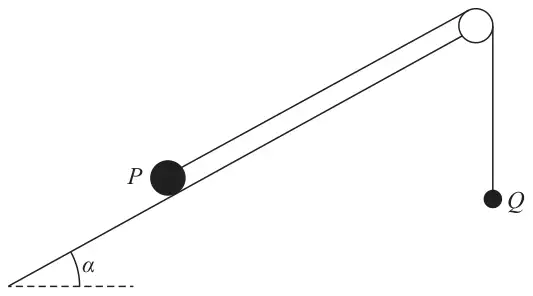
Two particles \(P\) and \(Q\) have mass 4 kg and 0.5 kg respectively. The particles are attached to the ends of a light inextensible string. Particle \(P\) is held at rest on a fixed rough plane, which is inclined to the horizontal at an angle \(\alpha\) where \(\tan\alpha = \dfrac{4}{3}\). The coefficient of friction between \(P\) and the plane is 0.5. The string lies along the plane and passes over a small smooth light pulley which is fixed at the top of the plane. Particle \(Q\) hangs freely at rest vertically below the pulley. The string lies in the vertical plane which contains the pulley and a line of greatest slope of the inclined plane, as shown in Figure 4. Particle \(P\) is released from rest with the string taut and slides down the plane.
Given that \(Q\) has not hit the pulley, find
| Scheme | Marks |
|---|---|
| \(R = 4g\cos\alpha\) | M1 A1 |
| \(T - 0.5g = 0.5a\) | M1 A1 |
| \(4g\sin\alpha - T - F = 4a\) | M1 A1 |
| (OR: \(\ 4g\sin\alpha - F - 0.5g = 4.5a\)) | |
| \(F = \dfrac{1}{2}R;\quad \sin\alpha = \dfrac{4}{5}\) or \(\cos\alpha = \dfrac{3}{5}\) | B1; B1 |
| Eliminating \(a\) or finding \(a\) | M1 |
| Solving for \(T\) (must have had an \(a\)) | M1 |
| \(T = \dfrac{2g}{3}\) N or 6.5 N or 6.53 N | A1 |
| (11) |
Notes
First M1 for resolving perp to plane, with usual criteria
First A1 for a correct equation
Second M1 for resolving vertically, with usual criteria
Second A1 for a correct equation, in terms of \(a\) and \(T\)
Third M1 for resolving parallel to the slope, with usual criteria.
Third A1 for a correct equation, in terms of \(a\), \(F\) and \(T\)
N.B. Their \(a\) could be UP the slope in which case all 4 marks for the 2 equations are available with \(-a\) replacing \(a\), provided they are consistent. If they are inconsistent, then assume the vertical resolution is the correct one and mark accordingly.
Either of the above two equations can be replaced by the ‘whole system’ equation
N.B. If they use \(a = 0\), in any of the above 3 equations, and they use the equation to find T, they lose both marks for that equation, and they lose the two M marks for eliminating and solving.
First B1 for \(F = \tfrac{1}{2}R\) seen or implied;
Second B1 for \(\sin\alpha = 0.8\) or \(\cos\alpha = 0.6\) seen or implied. Allow close approximations if \(\alpha = 53.1^\circ\ldots\) used.
Fourth M1 independent for eliminating \(a\) or finding \(a\).
Fifth M1 for solving for \(T\) but must have had an \(a\).
Fourth A1 for \(2g/3\), 6.5 or 6.53.
| Scheme | Marks |
|---|---|
| Magnitude \(= 2T\cos\left(\dfrac{90 - \alpha}{2}\right)\) | M1 A1 |
| \(= 2 \times \dfrac{2g}{3} \times \dfrac{3}{\sqrt{10}}\ \ (0.94868..)\) | A1 ft on \(T\) |
| \(= 12\) N or 12.4 N \(\left(\dfrac{4g}{\sqrt{10}}\right)\) | A1 |
| (4) | |
| (15 marks) |
Notes
First M1 for a complete method for finding the magnitude of the resultant (N.B. M0 if same tensions used)
\(2T\cos\left(\dfrac{90^\circ - \alpha}{2}\right)\). Allow sin/cos confusion and allow \(2T\cos\left(\dfrac{\alpha}{2}\right)\)
OR \(\sqrt{(T + T\sin\alpha)^2 + (T\cos\alpha)^2}\). Allow sin/cos confusion and allow omission of \(\sqrt{\ }\) sign, but only if \(R^2 = \ldots\) is included
OR \(\sqrt{T^2 + T^2 - 2T^2\cos(90^\circ + \alpha)}\). Allow \((90^\circ - \alpha)\) but must be cos and allow omission of \(\sqrt{\ }\) sign, but only if \(R^2 = \ldots\) is included
OR \(\dfrac{T\sin(90 + \alpha)}{\sin\left(\dfrac{90^\circ - \alpha}{2}\right)}\). (Sine Rule) Allow sign errors in angles but must be sin
First A1 for correct expression in terms of \(T\) and \(\alpha\)
Second A1, ft on their \(T\), for a ‘correct’ single numerical answer
Third A1 cao for 12 (N) or 12.4 (N)