
M1 June 2015 Q3
3.
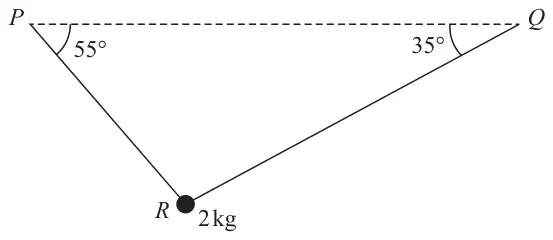
A particle of mass 2 kg is suspended from a horizontal ceiling by two light inextensible strings, \(PR\) and \(QR\). The particle hangs at \(R\) in equilibrium, with the strings in a vertical plane. The string \(PR\) is inclined at 55\(^\circ\) to the horizontal and the string \(QR\) is inclined at 35\(^\circ\) to the horizontal, as shown in Figure 1.
Find
| Scheme | Marks |
|---|---|
| \(T_P\cos 55 = T_Q\cos 35\) | M1 A1 |
| \(T_P\sin 55 + T_Q\sin 35 = 2g\) | M1 A1 |
| Eliminating \(T_P\) or \(T_Q\) | M1 |
| \(T_P = 16\) N or 16.1 N; \(\ T_Q = 11\) N or 11.2 N | A1 A1 |
| (7 marks) |
Notes
First M1 for resolving horizontally with correct no. of terms and both \(T_P\) and \(T_Q\) terms resolved. (M0 if they assume \(T_P = T_Q\))
First A1 for a correct equation.
Second M1 for resolving vertically with correct no. of terms and both \(T_P\) and \(T_Q\) terms resolved. (M0 if they assume \(T_P = T_Q\))
Second A1 for a correct equation.
Third M1 (independent) for eliminating either \(T_P\) or \(T_Q\)
Third A1 for \(T_P = 16\) (N) or 16.1 (N)
Fourth A1 for \(T_Q = 11\) (N) or 11.2 (N)
N.B. If both are given to more than 3SF, deduct the third A1.
ALT 1
| (Along \(RP\)) \(T_P = 2g\cos 35^\circ = 16\) N or 16.1 N | M1 M1 A1 A1 |
| (Along \(RQ\)) \(T_Q = 2g\cos 55^\circ = 11\) N or 11.2 N | M1 A1 A1 |
Alternative 1 (resolving along each string)
First M2 for resolving along one of the strings (e.g. \(T_P = 2g\cos 35^\circ\))
First A1 for a correct equation (\(T_P = 2g\sin 35^\circ\) scores M2A0A0)
Third A1 for \(T_P = 16\) (N) or 16.1 (N)
Third M1 for resolving along the other string (e.g. \(T_Q = 2g\cos 55^\circ\))
Second A1 for a correct equation (\(T_Q = 2g\sin 55^\circ\) scores M1A0A0)
Fourth A1 for \(T_Q = 11\) (N) or 11.2 (N)
ALT 2
Alternative 2 (using a Triangle of Forces)
Both of the equations in Alternative 1 could come from using sohcahtoa or The Sine Rule on a triangle of forces, so mark in the same way.
Note that, in either case, once they have found either \(T_P\) or \(T_Q\), they could then use \(T_P = T_Q\tan 55^\circ\) or \(T_Q = T_P\tan 35^\circ\) to find the other one. (Note that both of these are equivalent to the horizontal resolution) or Pythagoras.
e.g. \(T_P = 2g\cos 35^\circ = 16\) (N) or 16.1 (N) M2 First A1, Third A1
\(T_Q = T_P\tan 35^\circ\) or \(\sqrt{(2g)^2 - (T_P)^2} = 11\) (N) or 11.2 (N) M1 Second A1, Fourth A1
N.B. If they are clearly using The Sine Rule but have say 35\(^\circ\), 55\(^\circ\) and 80\(^\circ\) in their triangle, all 3 M marks would be available and at most 1 A mark
e.g. \(T_P = \dfrac{2g\sin 55}{\sin 80}\) M2 A0A0
\(T_Q = \dfrac{T_P\sin 35}{\sin 55}\) M1 SecondA1 A0
(Corrected from the printed mark scheme: the second relation is printed as \(T_Q = T_P\tan 55^\circ\).)