
M1 January 2011 Q7
7.
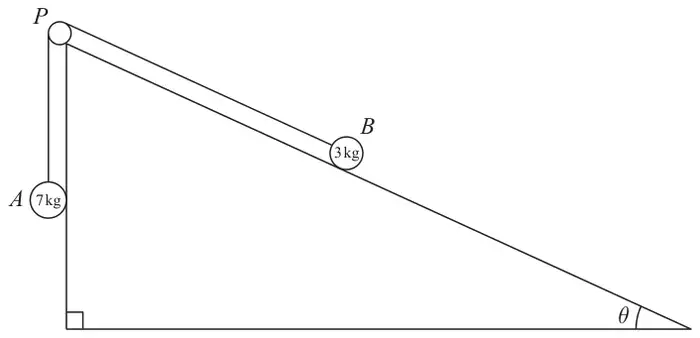
Two particles \(A\) and \(B\), of mass 7 kg and 3 kg respectively, are attached to the ends of a light inextensible string. Initially \(B\) is held at rest on a rough fixed plane inclined at angle \(\theta\) to the horizontal, where \(\tan\theta = \dfrac{5}{12}\). The part of the string from \(B\) to \(P\) is parallel to a line of greatest slope of the plane. The string passes over a small smooth pulley, \(P\), fixed at the top of the plane. The particle \(A\) hangs freely below \(P\), as shown in Figure 4. The coefficient of friction between \(B\) and the plane is \(\dfrac{2}{3}\). The particles are released from rest with the string taut and \(B\) moves up the plane.
When \(B\) has moved 1 m up the plane the string breaks. Given that in the subsequent motion \(B\) does not reach \(P\),
| Scheme | Marks |
|---|---|
| \(\tan\theta = \dfrac{5}{12}\), \(\sin\theta = \dfrac{5}{13}\), \(\cos\theta = \dfrac{12}{13}\) | |
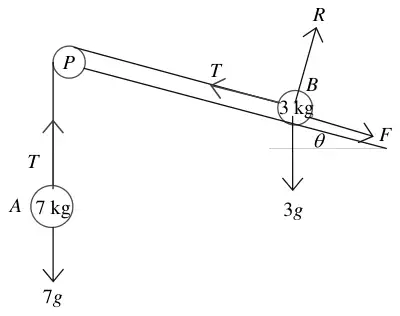
| For A: \(7g - T = 7a\) | M1 A1 |
| For B: parallel to plane \(T - F - 3g\sin\theta = 3a\) | M1 A1 |
| perpendicular to plane \(R = 3g\cos\theta\) | M1 A1 |
| \(F = \mu R = \tfrac{2}{3} \times 3g\cos\theta = 2g\cos\theta\) | M1 |
| Eliminating \(T\), \(7g - F - 3g\sin\theta = 10a\) | DM1 |
| Equation in \(g\) and \(a\): \(7g - 2g \times \dfrac{12}{13} - 3g\dfrac{5}{13} = 7g - \dfrac{39}{13}g = 4g = 10a\) | DM1 |
| \(a = \dfrac{2g}{5}\) oe or 3.9 or 3.92 | A1 |
| (10) |
Notes
(Corrected from the printed mark scheme: the friction line is printed as \(F = \mu R = 3g\cos\theta = 2g\cos\theta\), with the \(\tfrac{2}{3} \times\) missing.)
| Scheme | Marks |
|---|---|
| After 1 m, | |
| \(v^2 = u^2 + 2as\), \(v^2 = 0 + 2 \times \dfrac{2g}{5} \times 1\) | M1 |
| \(v = 2.8\) | A1 |
| (2) |
| Scheme | Marks |
|---|---|
| \(-(F + 3g\sin\theta) = 3a\) | M1 |
| \(\dfrac{2}{3} \times 3g \times \dfrac{12}{13} + 3g \times \dfrac{5}{13} = 3g = -3a\), \(a = -g\) | A1 |
| \(v = u + at\), \(0 = 2.8 - 9.8t\), | DM1 |
| \(t = \dfrac{2}{7}\) oe, 0.29, 0.286 | A1 |
| (4) | |
| (16 marks) |