
M1 January 2006 Q7
7.
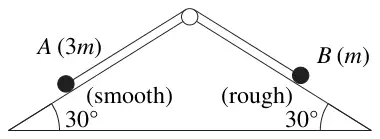
A fixed wedge has two plane faces, each inclined at 30\(^\circ\) to the horizontal. Two particles \(A\) and \(B\), of mass \(3m\) and \(m\) respectively, are attached to the ends of a light inextensible string. Each particle moves on one of the plane faces of the wedge. The string passes over a small smooth light pulley fixed at the top of the wedge. The face on which \(A\) moves is smooth. The face on which \(B\) moves is rough. The coefficient of friction between \(B\) and this face is \(\mu\). Particle \(A\) is held at rest with the string taut. The string lies in the same vertical plane as lines of greatest slope on each plane face of the wedge, as shown in Figure 3.
The particles are released from rest and start to move. Particle \(A\) moves downwards and \(B\) moves upwards. The accelerations of \(A\) and \(B\) each have magnitude \(\tfrac{1}{10}g\).
| Scheme | Marks |
|---|---|
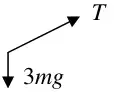
| \(A\): \(3mg\sin 30 - T = 3m.\tfrac{1}{10}g\) | M1 A1 |
| \(\Rightarrow T = \tfrac{6}{5}mg\) | A1 |
| (3) |
| Scheme | Marks |
|---|---|
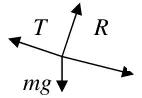
| \(F\): R(perp): \(R = mg\cos 30\) | M1 A1 |
| R(//): \(T - mg\sin 30 - F = m.\tfrac{1}{10}g\) | M1 A2, 1, 0 |
| Using \(F = \mu R\) | M1 |
| \(\dfrac{6}{5}mg - \dfrac{1}{2}mg - \mu mg\dfrac{\sqrt{3}}{2} = \dfrac{1}{10}mg\) | M1 |
| \(\rightarrow \mu = 0.693\) or 0.69 or \(\dfrac{2\sqrt{3}}{5}\) | A1 |
| (8) |
| Scheme | Marks |
|---|---|
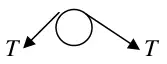
| Magn of force on pulley \(= 2T\cos 60 = \tfrac{6}{5}mg\) | M1 A1ft |
| Direction is vertically downwards | B1 (cso) |
| (3) | |
| (14 marks) |