
4400 Higher November 2005 Paper 4 Q15
15 The diagram shows the graph of \(y = x^3 - 12x + 17\)
\(A\) is the maximum point on the curve.
\(C\) is the minimum point on the curve.
The curve crosses the \(y\) axis at \(B\).
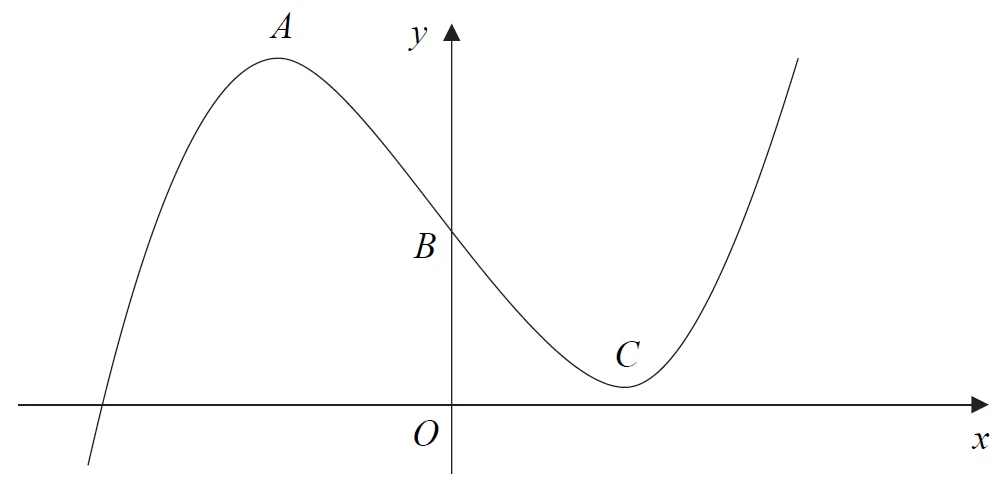
For the equation \(y = x^3 - 12x + 17\)
(a) find \(\dfrac{\mathrm{d}y}{\mathrm{d}x}\), (2)
(b) find the gradient of the curve at \(B\), (2)
(c) find the coordinates of \(A\) and \(C\). (4)
| Scheme | Marks |
|---|---|
| \(3x^2 - 12\) | B2 |
| (2) |
Notes
B2: B1 each term; −B1 for extra
| Scheme | Marks |
|---|---|
| \(3 \times 0^2 - 12\) | M1 |
| −12 | A1 |
| (2) |
| Scheme | Marks |
|---|---|
| (his \(3x^2 - 12\)) = 0 | M1 |
| \((x - 2)(x + 2) = 0\) or \((3x - 6)(x + 2) = 0\) oe | M1 |
| \(x = 2\) or \(-2\) or \((2, 1)\) | A1 |
| \(A\) is \((-2, 33)\), \(C\) is \((2, 1)\) | A1 |
| (4) | |
| (8 marks) |
Notes
M1: or \(x^2 = 4\)