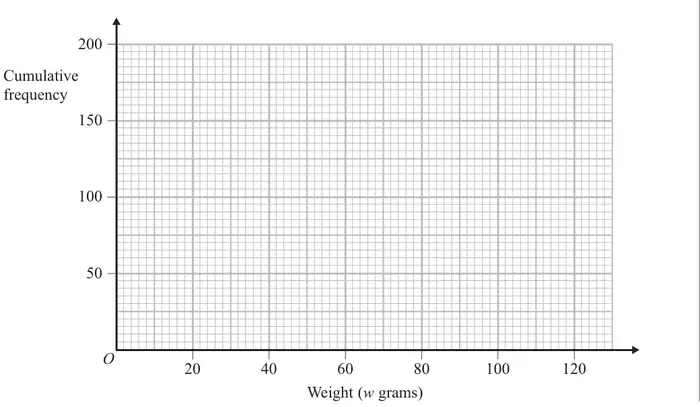
10 The grouped frequency table gives information about the weights of 180 airmail letters.
Weight (\(w\) grams)
Frequency
\(0 \lt w \leqslant 20\)
15
\(20 \lt w \leqslant 40\)
25
\(40 \lt w \leqslant 60\)
47
\(60 \lt w \leqslant 80\)
70
\(80 \lt w \leqslant 100\)
18
\(100 \lt w \leqslant 120\)
5
(a) Complete the cumulative frequency table.
Weight (\(w\) grams)
Cumulative frequency
\(0 \lt w \leqslant 20\)
\(0 \lt w \leqslant 40\)
\(0 \lt w \leqslant 60\)
\(0 \lt w \leqslant 80\)
\(0 \lt w \leqslant 100\)
\(0 \lt w \leqslant 120\)
(1)
(b) On the grid, draw a cumulative frequency graph for your table.(2)
(c) Find an estimate for the upper quartile of the weights of the 180 letters. (2)
Mark scheme (a)
Scheme
Marks
15 40 87 157 175 180
B1
(1)
Notes
B1: cao
Mark scheme (b)
Scheme
Marks
Points correct
B1
Curve or line segments
B1
(2)
Notes
B1: ± ½ sq
B1: ft from points if 4 or 5 correct or if points are plotted consistently within each interval at the correct heights Accept curve which is not joined to the origin
Mark scheme (c)
Scheme
Marks
135 or 135.75 indicated on cumulative frequency graph or stated
M1
approx 74 from correct graph
A1
(2)
Notes
M1: for 135 to 135.75 indicated on cumulative frequency graph or stated
A1: If M1 scored, ft from cumulative frequency graph If M1 not scored, ft only from correct curve & if answer is correct (± ½ sq tolerance) award M1 A1