
4MA0 Higher June 2013 Paper 3 Q15
15
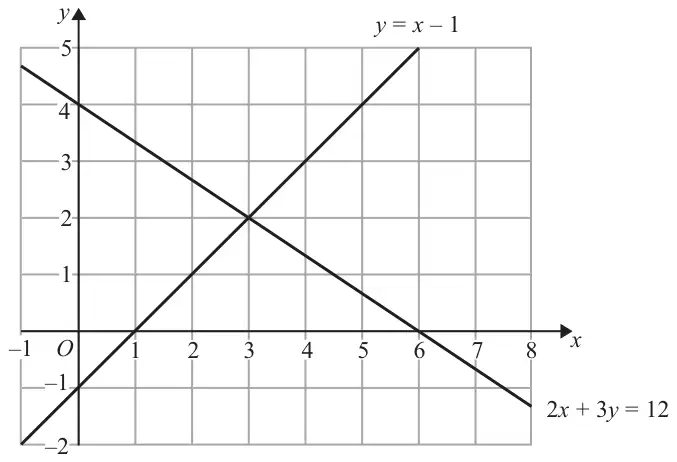
The diagram shows two straight lines.
The equations of the lines are \(y = x - 1\) and \(2x + 3y = 12\)
(a) Write down the solution of the simultaneous equations \[\begin{aligned} y &= x - 1 \\ 2x + 3y &= 12 \end{aligned}\] (1)
(b) Find an equation of the line which is parallel to the line with equation \(2x + 3y = 12\) and passes through the point (0, 10) (4)
(c) On the grid, mark with a cross (×) each point which satisfies both these inequalities
\(y > x - 1\) and \(2x + 3y < 12\) and whose coordinates are positive integers. (2)
\(y > x - 1\) and \(2x + 3y < 12\) and whose coordinates are positive integers. (2)
| Scheme | Marks |
|---|---|
| \(x = 3,\ y = 2\) | B1 |
| (1) |
Notes
B1: cao
| Scheme | Marks |
|---|---|
Use of gradient and \(y = mx + c\) or clear attempt to use \(\dfrac{\text{vertical difference}}{\text{horizontal difference}}\) eg \(\dfrac{2}{3}\) oe (ignore omission of − sign) or for \(3y = 12 - 2x\) or \(3y = -2x + 12\) or for \(y = \dfrac{12 - 2x}{3}\) oe or gradient = \(\dfrac{2}{3}\) stated or used | M1 |
| (grad =) \(-\dfrac{2}{3}\) oe or \(y = 4 - \dfrac{2}{3}x\) oe | A1 |
\(y = -\dfrac{2}{3}x + c\) or for \(y = \text{“}{-\tfrac{2}{3}}\text{”}x + c\) where \(c \neq 10\) or \(-\dfrac{2}{3}x + 10\), \(\text{“}{-\tfrac{2}{3}}\text{”}x + 10\), L\(= -\dfrac{2}{3}x + 10\) etc | M1 |
\(y = -\dfrac{2}{3}x + 10\) oe or \(2x + 3y = 30\) oe or \(y = \text{“}{-\tfrac{2}{3}}\text{”}x + 10\) oe | A1 |
| (4) |
Notes
M1: Throughout question accept \(\dfrac{2}{3}\) written as a decimal rounded or truncated to 2 or more decimal places
M1: ft from “\(-\dfrac{2}{3}\)”
A1: ft from “\(-\dfrac{2}{3}\)”
Alternative scheme: Use of \(2x + 3y = k\)
| Scheme | Marks |
|---|---|
| \(2x + 3y = k\) | M1 |
| 2× 0 + 3×10 (=\(k\)) | M1 |
| \(k = 30\) | A1 |
| \(2x + 3y = 30\) oe | A1 |
Notes
M1: Substitution of (0, 10) into \(2x + 3y = k\)
| Scheme | Marks |
|---|---|
| (1,1) (1,2) (1,3) (2,2) marked | B2 |
| (2) |
Notes
B2: B1 for 3 correct points marked and none wrong
or for all correct points and either one or more of points on \(y\) axis ie. (0,−1) (0,0) (0,1) (0,2) (0,3) (0,4)
points on \(y = x - 1\) ie (0,−1) (1,0) (2,1) (3,2)