
4400 Higher June 2010 Paper 4 Q21
21
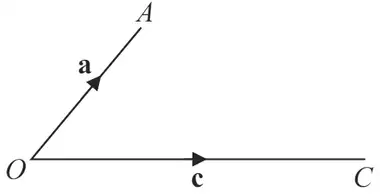
Diagram NOT accurately drawn
In the diagram \(\overrightarrow{OA} = \mathbf{a}\) and \(\overrightarrow{OC} = \mathbf{c}\).
(a) Find \(\overrightarrow{CA}\) in terms of \(\mathbf{a}\) and \(\mathbf{c}\). (1)
(b) The point \(B\) is such that \(\overrightarrow{AB} = \frac{1}{2}\mathbf{c}\).
Give the mathematical name for the quadrilateral \(OABC\). (1)
Give the mathematical name for the quadrilateral \(OABC\). (1)
(c) The point \(P\) is such that \(\overrightarrow{OP} = \mathbf{a} + k\mathbf{c}\), where \(k \geqslant 0\)
State the two conditions relating to \(\mathbf{a} + k\mathbf{c}\) that must be true for \(OAPC\) to be a rhombus. (2)
State the two conditions relating to \(\mathbf{a} + k\mathbf{c}\) that must be true for \(OAPC\) to be a rhombus. (2)
| Scheme | Marks |
|---|---|
| \(\mathbf{a} - \mathbf{c}\) oe | B1 |
| (1) |
| Scheme | Marks |
|---|---|
| trapezium | B1 |
| (1) |
| Scheme | Marks |
|---|---|
| \(k = 1\) | B1 |
| (mag) \(\mathbf{a}\) = (mag) \(\mathbf{c}\) oe | B1 |
| (2) | |
| (4 marks) |
Notes
B1: Accept \(\{\mathbf{a} + k\mathbf{c} = \mathbf{a} + \mathbf{c}\}\) or \(\{k\mathbf{c} = \mathbf{c}\}\) all imply \(k = 1\)
B1: Accept \(\mathbf{a} = \mathbf{c}\) or \(\{\mathbf{a} = k\mathbf{c}\}\) (imply sides are equal in length) or \(\mathbf{a} + k\mathbf{c}\) bisects angle \(AOC\)