
4400 Higher June 2009 Paper 4 Q18
18 The diagram shows a parallelogram, \(ABCD\).
\(M\) is the midpoint of \(BC\).
\(N\) is the midpoint of \(AD\).
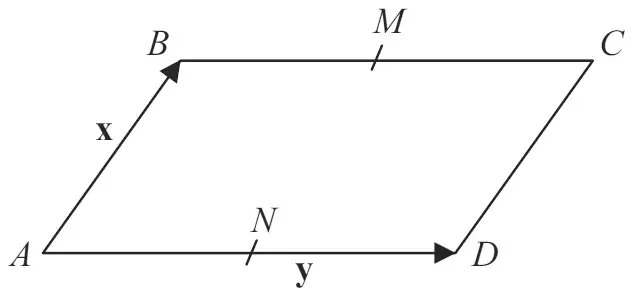
Diagram NOT accurately drawn
\(\overrightarrow{AB} = \mathbf{x}\)
\(\overrightarrow{AD} = \mathbf{y}\)
Find, in terms of \(\mathbf{x}\) and/or \(\mathbf{y}\), the vectors
(a) \(\overrightarrow{MN}\) (1)
(b) \(\overrightarrow{AC}\) (1)
\(P\) is the point such that \(\overrightarrow{CP} = \mathbf{y} - \frac{1}{2}\mathbf{x}\)
(c) Find, in terms of \(\mathbf{x}\) and/or \(\mathbf{y}\), the vector \(\overrightarrow{PA}\)
Simplify your answer as much as possible. (3)
Simplify your answer as much as possible. (3)
| Scheme | Marks |
|---|---|
| \(-\mathbf{x}\) oe | B1 |
| (1) |
Notes
B1: can be unsimplified
| Scheme | Marks |
|---|---|
| \(\mathbf{x} + \mathbf{y}\) oe | B1 |
| (1) |
Notes
B1: can be unsimplified
| Scheme | Marks |
|---|---|
| Unsimplified expression in terms of \(x\) and \(y\) for \(PA\) or \(AP\) (either correct or ft from b) e.g. \((AP =)\) “\(\mathbf{x} + \mathbf{y}\)” \(+ \mathbf{y} - \frac{1}{2}\mathbf{x}\) or \((PA =)\) \(\frac{1}{2}\mathbf{x} - \mathbf{y} -\) “\(\mathbf{x} + \mathbf{y}\)” | B2 |
| \(-0.5\mathbf{x} - 2\mathbf{y}\) | B1 |
| (3) | |
| (5 marks) |
Notes
B2: B1 Correct vector statement with at least 3 terms including \(AP\) or \(PA\) e.g. \(PA = PC + CA\) or \(AP = AC + CP\) can include \(x\) and/or \(y\)
B1: cao