
C4 June 2015 Q3
3.
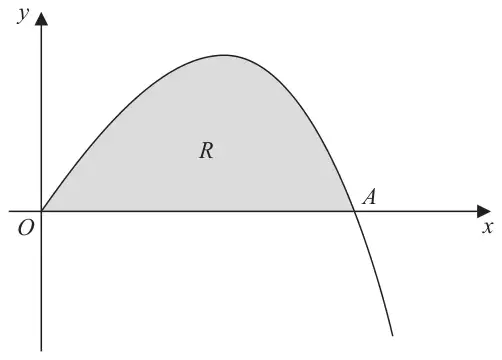
Figure 1 shows a sketch of part of the curve with equation \(y = 4x - x\mathrm{e}^{\frac{1}{2}x},\ x \geqslant 0\)
The curve meets the \(x\)-axis at the origin \(O\) and cuts the \(x\)-axis at the point \(A\).
The finite region \(R\), shown shaded in Figure 1, is bounded by the \(x\)-axis and the curve with equation \[y = 4x - x\mathrm{e}^{\frac{1}{2}x},\ x \geqslant 0\]
Give your answer in terms of \(\ln 2\) (3)
| Scheme | Marks |
|---|---|
| \(y = 4x - x\mathrm{e}^{\frac{1}{2}x},\ x \geqslant 0\) | |
| \(\left\{y = 0 \Rightarrow 4x - x\mathrm{e}^{\frac{1}{2}x} = 0 \Rightarrow x(4 - \mathrm{e}^{\frac{1}{2}x}) = 0 \Rightarrow\right\}\) | |
| \(\mathrm{e}^{\frac{1}{2}x} = 4 \Rightarrow x_A = 4\ln 2\) Attempts to solve \(\mathrm{e}^{\frac{1}{2}x} = 4\) giving \(x = \ldots\) in terms of \(\pm\lambda\ln\mu\) where \(\mu > 0\) \(4\ln 2\) cao (Ignore \(x = 0\)) | M1 A1 |
| (2) |
Notes
M1: Attempts to solve \(\mathrm{e}^{\frac{1}{2}x} = 4\) giving \(x = \ldots\) in terms of \(\pm\lambda\ln\mu\) where \(\mu > 0\)
A1: \(4\ln 2\) cao stated in part (a) only (Ignore \(x = 0\))
| Scheme | Marks |
|---|---|
| \(\left\{\displaystyle\int x\mathrm{e}^{\frac{1}{2}x}\,\mathrm{d}x\right\} = 2x\mathrm{e}^{\frac{1}{2}x} - \displaystyle\int 2\mathrm{e}^{\frac{1}{2}x}\,\{\mathrm{d}x\}\) \(\alpha x\mathrm{e}^{\frac{1}{2}x} - \beta\displaystyle\int \mathrm{e}^{\frac{1}{2}x}\,\{\mathrm{d}x\},\ \alpha > 0, \beta > 0\) \(2x\mathrm{e}^{\frac{1}{2}x} - \displaystyle\int 2\mathrm{e}^{\frac{1}{2}x}\,\{\mathrm{d}x\}\), with or without \(\mathrm{d}x\) | M1 A1 (M1 on ePEN) |
| \(= 2x\mathrm{e}^{\frac{1}{2}x} - 4\mathrm{e}^{\frac{1}{2}x}\ \{+c\}\) \(2x\mathrm{e}^{\frac{1}{2}x} - 4\mathrm{e}^{\frac{1}{2}x}\) o.e. with or without \(+c\) | A1 |
| (3) |
Notes
NOTE: Part (b) appears as M1M1A1 on ePEN, but is now marked as M1A1A1.
M1: Integration by parts is applied in the form \(\alpha x\mathrm{e}^{\frac{1}{2}x} - \beta\displaystyle\int \mathrm{e}^{\frac{1}{2}x}\,\{\mathrm{d}x\}\), where \(\alpha > 0, \beta > 0\). (must be in this form) with or without \(\mathrm{d}x\)
A1: \(2x\mathrm{e}^{\frac{1}{2}x} - \displaystyle\int 2\mathrm{e}^{\frac{1}{2}x}\,\{\mathrm{d}x\}\) or equivalent, with or without \(\mathrm{d}x\). Can be un-simplified.
A1: \(2x\mathrm{e}^{\frac{1}{2}x} - 4\mathrm{e}^{\frac{1}{2}x}\) or equivalent with or without \(+c\). Can be un-simplified.
Note: You can also allow \(2\mathrm{e}^{\frac{1}{2}x}(x - 2)\) or \(\mathrm{e}^{\frac{1}{2}x}(2x - 4)\) for the final A1.
isw: You can ignore subsequent working following on from a correct solution.
SC: SPECIAL CASE: A candidate who uses \(u = x\), \(\dfrac{\mathrm{d}v}{\mathrm{d}x} = \mathrm{e}^{\frac{1}{2}x}\), writes down the correct “by parts” formula, but makes only one error when applying it can be awarded Special Case M1. (Applying their \(v\) counts for one consistent error.)
| Scheme | Marks |
|---|---|
| \(\left\{\displaystyle\int 4x\,\mathrm{d}x\right\} = 2x^2\) \(4x \to 2x^2\) or \(\dfrac{4x^2}{2}\) o.e. | B1 |
| \(\left\{\displaystyle\int_0^{4\ln 2} (4x - x\mathrm{e}^{\frac{1}{2}x})\,\mathrm{d}x\right\} = \left[2x^2 - \left(2x\mathrm{e}^{\frac{1}{2}x} - 4\mathrm{e}^{\frac{1}{2}x}\right)\right]_0^{4\ln 2 \text{ or } \ln 16 \text{ or their limits}}\) | |
| \(= \left(2(4\ln 2)^2 - 2(4\ln 2)\mathrm{e}^{\frac{1}{2}(4\ln 2)} + 4\mathrm{e}^{\frac{1}{2}(4\ln 2)}\right) - \left(2(0)^2 - 2(0)\mathrm{e}^{\frac{1}{2}(0)} + 4\mathrm{e}^{\frac{1}{2}(0)}\right)\) See notes | M1 |
| \(= \left(32(\ln 2)^2 - 32(\ln 2) + 16\right) - (4)\) | |
| \(= 32(\ln 2)^2 - 32(\ln 2) + 12\) \(32(\ln 2)^2 - 32(\ln 2) + 12\), see notes | A1 |
| (3) | |
| (8 marks) |
Notes
B1: \(4x \to 2x^2\) or \(\dfrac{4x^2}{2}\) oe
M1: Complete method of applying limits of their \(x_A\) and 0 to all terms of an expression of the form \(\pm Ax^2 \pm Bx\mathrm{e}^{\frac{1}{2}x} \pm C\mathrm{e}^{\frac{1}{2}x}\) (where \(A \neq 0\), \(B \neq 0\) and \(C \neq 0\)) and subtracting the correct way round.
Note: Evidence of a proper consideration of the limit of 0 is needed for M1. So subtracting 0 is M0.
Note: \(\ln 16\) or \(2\ln 4\) or equivalent is fine as an upper limit.
A1: A correct three term exact quadratic expression in \(\ln 2\).
For example allow for A1
- \(32(\ln 2)^2 - 32(\ln 2) + 12\)
- \(8(2\ln 2)^2 - 8(4\ln 2) + 12\)
- \(2(4\ln 2)^2 - 32(\ln 2) + 12\)
- \(2(4\ln 2)^2 - 2(4\ln 2)\mathrm{e}^{\frac{1}{2}(4\ln 2)} + 12\)
Note: Note that the constant term of 12 needs to be combined from \(4\mathrm{e}^{\frac{1}{2}(4\ln 2)} - 4\mathrm{e}^{\frac{1}{2}(0)}\) o.e.
Note: Also allow \(32\ln 2(\ln 2 - 1) + 12\) or \(32\ln 2\left(\ln 2 - 1 + \dfrac{12}{32\ln 2}\right)\) for A1.
Note: Do not apply “ignore subsequent working” for incorrect simplification.
Eg: \(32(\ln 2)^2 - 32(\ln 2) + 12 \to 64(\ln 2) - 32(\ln 2) + 12\) or \(32(\ln 4) - 32(\ln 2) + 12\)
Note: Bracketing error: \(32\ln 2^2 - 32(\ln 2) + 12\), unless recovered is final A0.
Note: Notation: Allow \(32(\ln^2 2) - 32(\ln 2) + 12\) for the final A1.
Note: 5.19378… without seeing \(32(\ln 2)^2 - 32(\ln 2) + 12\) is A0.
Note: 5.19378… following from a correct \(2x^2 - \left(2x\mathrm{e}^{\frac{1}{2}x} - 4\mathrm{e}^{\frac{1}{2}x}\right)\) is M1A0.
Note: 5.19378… from no working is M0A0.