
C4 June 2007 Q6
6. A curve has parametric equations\[x = \tan^2 t, \qquad y = \sin t, \qquad 0 \lt t \lt \frac{\pi}{2}.\]
Give your answer in the form \(y = ax + b\), where \(a\) and \(b\) are constants to be determined. (5)
| Scheme | Marks |
|---|---|
| \(x = \tan^2 t,\quad y = \sin t\) | |
| \(\dfrac{\mathrm{d}x}{\mathrm{d}t} = 2(\tan t)\sec^2 t,\ \dfrac{\mathrm{d}y}{\mathrm{d}t} = \cos t\) | B1 |
| \(\therefore \dfrac{\mathrm{d}y}{\mathrm{d}x} = \dfrac{\cos t}{2\tan t\sec^2 t}\quad \left(= \dfrac{\cos^4 t}{2\sin t}\right)\) | M1 A1ft |
| (3) |
Notes
B1: Correct \(\dfrac{\mathrm{d}x}{\mathrm{d}t}\) and \(\dfrac{\mathrm{d}y}{\mathrm{d}t}\)
M1: \(\dfrac{\pm\cos t}{\text{their } \frac{\mathrm{d}x}{\mathrm{d}t}}\) A1ft: \(\dfrac{+\cos t}{\text{their } \frac{\mathrm{d}x}{\mathrm{d}t}}\)
| Scheme | Marks |
|---|---|
| When \(t = \tfrac{\pi}{4}\), \(x = 1,\ y = \tfrac{1}{\sqrt{2}}\) (need values) | B1, B1 |
| When \(t = \dfrac{\pi}{4}\), m(T) \(= \dfrac{\mathrm{d}y}{\mathrm{d}x} = \dfrac{\cos\frac{\pi}{4}}{2\tan\frac{\pi}{4}\sec^2\frac{\pi}{4}}\) | |
| \(= \underline{\dfrac{\frac{1}{\sqrt{2}}}{2.(1)\left(\frac{1}{\frac{1}{\sqrt{2}}}\right)^2}} = \underline{\dfrac{\frac{1}{\sqrt{2}}}{2.(1)\left(\frac{1}{\frac{1}{2}}\right)}} = \underline{\dfrac{\frac{1}{\sqrt{2}}}{2.(1)(2)}} = \underline{\dfrac{1}{4\sqrt{2}}} = \underline{\dfrac{\sqrt{2}}{8}}\) | B1 aef |
| T: \(y - \tfrac{1}{\sqrt{2}} = \tfrac{1}{4\sqrt{2}}(x - 1)\) | M1ft aef |
| T: \(\underline{y = \tfrac{1}{4\sqrt{2}}x + \tfrac{3}{4\sqrt{2}}}\) or \(\underline{y = \tfrac{\sqrt{2}}{8}x + \tfrac{3\sqrt{2}}{8}}\) | A1 aef cso |
| or \(\tfrac{1}{\sqrt{2}} = \tfrac{1}{4\sqrt{2}}(1) + c \Rightarrow c = \tfrac{1}{\sqrt{2}} - \tfrac{1}{4\sqrt{2}} = \tfrac{3}{4\sqrt{2}}\) | |
| Hence T: \(\underline{y = \tfrac{1}{4\sqrt{2}}x + \tfrac{3}{4\sqrt{2}}}\) or \(\underline{y = \tfrac{\sqrt{2}}{8}x + \tfrac{3\sqrt{2}}{8}}\) | |
| (5) |
Notes
B1, B1: The point \(\underline{\left(1, \tfrac{1}{\sqrt{2}}\right)}\) or \(\underline{(1, \text{awrt } 0.71)}\). These coordinates can be implied. (\(y = \sin\left(\tfrac{\pi}{4}\right)\) is not sufficient for B1)
B1 aef: any of the five underlined expressions or awrt 0.18
M1ft aef: Finding an equation of a tangent with their point and their tangent gradient or finds \(c\) by using \(y = \underline{(\text{their gradient})}x + \underline{\text{“}c\text{”}}\).
A1 aef cso: Correct simplified EXACT equation of tangent
Note: The x and y coordinates must be the right way round.
A candidate who incorrectly differentiates \(\tan^2 t\) to give \(\tfrac{\mathrm{d}x}{\mathrm{d}t} = 2\sec^2 t\) or \(\tfrac{\mathrm{d}x}{\mathrm{d}t} = \sec^4 t\) is then able to fluke the correct answer in part (b). Such candidates can potentially get: (a) B0M1A1ft (b) B1B1B1M1A0 cso.
Note: cso means “correct solution only”.
Note: part (a) not fully correct implies candidate can achieve a maximum of 4 out of 5 marks in part (b).
Way 1
| Scheme | Marks |
|---|---|
| \(x = \tan^2 t = \dfrac{\sin^2 t}{\cos^2 t}\qquad y = \sin t\) | |
| \(x = \dfrac{\sin^2 t}{1 - \sin^2 t}\) | M1 |
| \(x = \dfrac{y^2}{1 - y^2}\) | M1 |
| \(x(1 - y^2) = y^2 \Rightarrow x - xy^2 = y^2\) | |
| \(x = y^2 + xy^2 \Rightarrow x = y^2(1 + x)\) | ddM1 |
| \(y^2 = \dfrac{x}{1 + x}\) | A1 |
| (4) | |
| (12 marks) |
Notes
M1: Uses \(\cos^2 t = 1 - \sin^2 t\). M1: Eliminates ‘\(t\)’ to write an equation involving \(x\) and \(y\). ddM1: Rearranging and factorising with an attempt to make \(y^2\) the subject. A1: \(\dfrac{x}{1+x}\)
\(\dfrac{1}{1+\frac{1}{x}}\) is an acceptable response for the final accuracy A1 mark.
Aliter 6. (c) Way 2
| Scheme | Marks |
|---|---|
| \(1 + \cot^2 t = \mathrm{cosec}^2 t\) | M1 |
| \(= \dfrac{1}{\sin^2 t}\) | M1 implied |
| Hence, \(1 + \dfrac{1}{x} = \dfrac{1}{y^2}\) | ddM1 |
| Hence, \(y^2 = 1 - \dfrac{1}{(1+x)}\) or \(\dfrac{x}{1+x}\) | A1 |
| (4) |
M1: Uses \(1 + \cot^2 t = \mathrm{cosec}^2 t\). M1 implied: Uses \(\mathrm{cosec}^2 t = \dfrac{1}{\sin^2 t}\). ddM1: Eliminates ‘\(t\)’ to write an equation involving \(x\) and \(y\). A1: \(1 - \dfrac{1}{(1+x)}\) or \(\dfrac{x}{1+x}\)
\(\dfrac{1}{1+\frac{1}{x}}\) is an acceptable response for the final accuracy A1 mark.
Aliter 6. (c) Way 3
| Scheme | Marks |
|---|---|
| \(x = \tan^2 t\qquad y = \sin t\) | |
| \(1 + \tan^2 t = \sec^2 t\) | M1 |
| \(= \dfrac{1}{\cos^2 t}\) | M1 |
| \(= \dfrac{1}{1 - \sin^2 t}\) | |
| Hence, \(1 + x = \dfrac{1}{1 - y^2}\) | ddM1 |
| Hence, \(y^2 = 1 - \dfrac{1}{(1+x)}\) or \(\dfrac{x}{1+x}\) | A1 |
| (4) |
M1: Uses \(1 + \tan^2 t = \sec^2 t\). M1: Uses \(\sec^2 t = \dfrac{1}{\cos^2 t}\). ddM1: Eliminates ‘\(t\)’ to write an equation involving \(x\) and \(y\). A1: \(1 - \dfrac{1}{(1+x)}\) or \(\dfrac{x}{1+x}\)
Aliter 6. (c) Way 4
| Scheme | Marks |
|---|---|
| \(y^2 = \sin^2 t = 1 - \cos^2 t\) | M1 |
| \(= 1 - \dfrac{1}{\sec^2 t}\) | M1 |
| \(= 1 - \dfrac{1}{(1 + \tan^2 t)}\) | ddM1 |
| Hence, \(y^2 = 1 - \dfrac{1}{(1+x)}\) or \(\dfrac{x}{1+x}\) | A1 |
| (4) |
M1: Uses \(\sin^2 t = 1 - \cos^2 t\). M1: Uses \(\cos^2 t = \dfrac{1}{\sec^2 t}\). ddM1: then uses \(\sec^2 t = 1 + \tan^2 t\). A1: \(1 - \dfrac{1}{(1+x)}\) or \(\dfrac{x}{1+x}\)
\(\dfrac{1}{1+\frac{1}{x}}\) is an acceptable response for the final accuracy A1 mark.
Aliter 6. (c) Way 5
| Scheme | Marks |
|---|---|
| \(x = \tan^2 t\qquad y = \sin t\) | |
| \(x = \tan^2 t \Rightarrow \tan t = \sqrt{x}\) | |
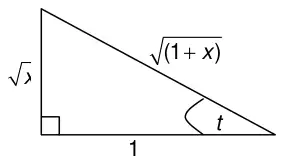 | M1 M1 |
| Hence, \(y = \sin t = \dfrac{\sqrt{x}}{\sqrt{1+x}}\) | ddM1 |
| Hence, \(y^2 = \dfrac{x}{1+x}\) | A1 |
| (4) |
M1: Draws a right-angled triangle and places both \(\sqrt{x}\) and 1 on the triangle. M1: Uses Pythagoras to deduce the hypotenuse. ddM1: Eliminates ‘\(t\)’ to write an equation involving \(x\) and \(y\). A1: \(\dfrac{x}{1+x}\)
\(\dfrac{1}{1+\frac{1}{x}}\) is an acceptable response for the final accuracy A1 mark.
There are so many ways that a candidate can proceed with part (c). If a candidate produces a correct solution then please award all four marks. If they use a method commensurate with the five ways as detailed on the mark scheme then award the marks appropriately. If you are unsure of how to apply the scheme please escalate your response up to your team leader.