
C4 January 2008 Q7
7.
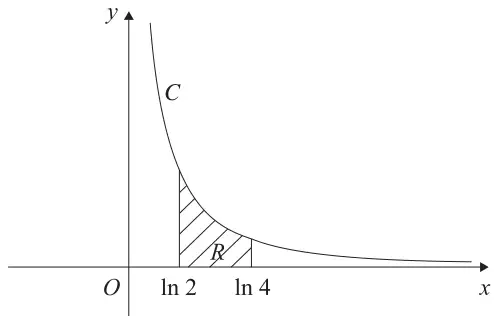
The curve \(C\) has parametric equations\[x = \ln(t + 2), \qquad y = \frac{1}{(t+1)}, \qquad t \gt -1.\]The finite region \(R\) between the curve \(C\) and the \(x\)-axis, bounded by the lines with equations \(x = \ln 2\) and \(x = \ln 4\), is shown shaded in Figure 3.
| Scheme | Marks |
|---|---|
| \(\left[x = \ln(t+2),\ y = \dfrac{1}{t+1}\right], \quad \Rightarrow \dfrac{\mathrm{d}x}{\mathrm{d}t} = \dfrac{1}{t+2}\) | B1 |
| \(\text{Area}(R) = \displaystyle\int_{\ln 2}^{\ln 4}\frac{1}{t+1}\,\mathrm{d}x;\ = \int_0^2\left(\frac{1}{t+1}\right)\left(\frac{1}{t+2}\right)\mathrm{d}t\) | M1; A1 AG |
| Changing limits, when: \(x = \ln 2 \Rightarrow \ln 2 = \ln(t+2) \Rightarrow 2 = t + 2 \Rightarrow t = 0\) \(x = \ln 4 \Rightarrow \ln 4 = \ln(t+2) \Rightarrow 4 = t + 2 \Rightarrow t = 2\) | B1 |
| Hence, \(\text{Area}(R) = \displaystyle\int_0^2\frac{1}{(t+1)(t+2)}\,\mathrm{d}t\) | |
| (4) |
Notes
B1: Must state \(\dfrac{\mathrm{d}x}{\mathrm{d}t} = \dfrac{1}{t+2}\)
M1: Area \(= \displaystyle\int\frac{1}{t+1}\,\mathrm{d}x\). Ignore limits. A1 AG: \(\displaystyle\int\left(\frac{1}{t+1}\right)\times\left(\frac{1}{t+2}\right)\mathrm{d}t\). Ignore limits.
B1: changes limits \(x \to t\) so that \(\ln 2 \to 0\) and \(\ln 4 \to 2\)
| Scheme | Marks |
|---|---|
| \(\left(\dfrac{1}{(t+1)(t+2)}\right) = \dfrac{A}{(t+1)} + \dfrac{B}{(t+2)}\) | M1 |
| \(1 = A(t+2) + B(t+1)\) | |
| Let \(t = -1\), \(1 = A(1) \Rightarrow \underline{A = 1}\) Let \(t = -2\), \(1 = B(-1) \Rightarrow \underline{B = -1}\) | A1 |
| \(\displaystyle\int_0^2\frac{1}{(t+1)(t+2)}\,\mathrm{d}t = \int_0^2\frac{1}{(t+1)} - \frac{1}{(t+2)}\,\mathrm{d}t\) | |
| \(= \big[\ln(t+1) - \ln(t+2)\big]_0^2\) | dM1 A1ft |
| \(= (\ln 3 - \ln 4) - (\ln 1 - \ln 2)\) | ddM1 |
| \(= \ln 3 - \ln 4 + \ln 2 = \ln 3 - \ln 2 = \ln\left(\tfrac{3}{2}\right)\) | A1 aef isw |
| (6) |
Notes
M1: \(\dfrac{A}{(t+1)} + \dfrac{B}{(t+2)}\) with \(A\) and \(B\) found
A1: Finds both \(A\) and \(B\) correctly. Can be implied. (See note below)
dM1: Either \(\pm a\ln(t+1)\) or \(\pm b\ln(t+2)\). A1ft: Both ln terms correctly ft.
ddM1: Substitutes both limits of 2 and 0 and subtracts the correct way round.
A1 aef isw: \(\underline{\ln 3 - \ln 4 + \ln 2}\) or \(\underline{\ln\left(\tfrac{3}{4}\right) - \ln\left(\tfrac{1}{2}\right)}\) or \(\underline{\ln 3 - \ln 2}\) or \(\underline{\ln\left(\tfrac{3}{2}\right)}\) (must deal with ln 1). (\(\ln 3 - \ln 4 + \ln 2\): takes out brackets.)
Writing down \(\dfrac{1}{(t+1)(t+2)} = \dfrac{1}{(t+1)} + \dfrac{1}{(t+2)}\) means first M1A0 in (b).
Writing down \(\dfrac{1}{(t+1)(t+2)} = \dfrac{1}{(t+1)} - \dfrac{1}{(t+2)}\) means first M1A1 in (b).
| Scheme | Marks |
|---|---|
| \(x = \ln(t+2), \quad y = \dfrac{1}{t+1}\) | |
| \(\mathrm{e}^x = t + 2 \Rightarrow t = \mathrm{e}^x - 2\) | M1 A1 |
| \(y = \dfrac{1}{\mathrm{e}^x - 2 + 1} \Rightarrow y = \dfrac{1}{\mathrm{e}^x - 1}\) | dM1 A1 |
| (4) |
Notes
M1: Attempt to make \(t = \ldots\) the subject A1: giving \(t = \mathrm{e}^x - 2\)
dM1: Eliminates \(t\) by substituting in \(y\) A1: giving \(y = \dfrac{1}{\mathrm{e}^x - 1}\)
Aliter 7. (c) Way 2
| Scheme | Marks |
|---|---|
| \(t + 1 = \dfrac{1}{y} \Rightarrow t = \dfrac{1}{y} - 1\) or \(t = \dfrac{1-y}{y}\) \(y(t+1) = 1 \Rightarrow yt + y = 1 \Rightarrow yt = 1 - y \Rightarrow t = \dfrac{1-y}{y}\) | M1 A1 |
| \(x = \ln\left(\dfrac{1}{y} - 1 + 2\right)\) or \(x = \ln\left(\dfrac{1-y}{y} + 2\right)\) | dM1 |
| \(x = \ln\left(\dfrac{1}{y} + 1\right)\) | |
| \(\mathrm{e}^x = \dfrac{1}{y} + 1\) | |
| \(\mathrm{e}^x - 1 = \dfrac{1}{y}\) | |
| \(y = \dfrac{1}{\mathrm{e}^x - 1}\) | A1 |
| (4) |
M1: Attempt to make \(t = \ldots\) the subject A1: Giving either \(t = \dfrac{1}{y} - 1\) or \(t = \dfrac{1-y}{y}\) dM1: Eliminates \(t\) by substituting in \(x\) A1: giving \(y = \dfrac{1}{\mathrm{e}^x - 1}\)
Aliter 7. (c) Way 3
| Scheme | Marks |
|---|---|
| \(\mathrm{e}^x = t + 2 \Rightarrow t + 1 = \mathrm{e}^x - 1\) | M1 A1 |
| \(y = \dfrac{1}{t+1} \Rightarrow y = \dfrac{1}{\mathrm{e}^x - 1}\) | dM1 A1 |
| (4) |
M1: Attempt to make \(t + 1 = \ldots\) the subject A1: giving \(t + 1 = \mathrm{e}^x - 1\) dM1: Eliminates \(t\) by substituting in \(y\) A1: giving \(y = \dfrac{1}{\mathrm{e}^x - 1}\)
Aliter 7. (c) Way 4
| Scheme | Marks |
|---|---|
| \(t + 1 = \dfrac{1}{y} \Rightarrow t + 2 = \dfrac{1}{y} + 1\) or \(t + 2 = \dfrac{1+y}{y}\) | M1 A1 |
| \(x = \ln\left(\dfrac{1}{y} + 1\right)\) or \(x = \ln\left(\dfrac{1+y}{y}\right)\) | dM1 |
| \(x = \ln\left(\dfrac{1}{y} + 1\right)\) | |
| \(\mathrm{e}^x = \dfrac{1}{y} + 1 \Rightarrow \mathrm{e}^x - 1 = \dfrac{1}{y}\) | |
| \(y = \dfrac{1}{\mathrm{e}^x - 1}\) | A1 |
| (4) |
M1: Attempt to make \(t + 2 = \ldots\) the subject A1: Either \(t + 2 = \dfrac{1}{y} + 1\) or \(t + 2 = \dfrac{1+y}{y}\) dM1: Eliminates \(t\) by substituting in \(x\) A1: giving \(y = \dfrac{1}{\mathrm{e}^x - 1}\)
| Scheme | Marks |
|---|---|
| Domain: \(\underline{x \gt 0}\) | B1 |
| (1) | |
| (15 marks) |
Notes
B1: \(\underline{x \gt 0}\) or just \(\gt 0\)